Teething in Puppies: Milk Teeth and What to Do

It often starts quite unspectacularly: the puppy suddenly chews on everything that comes between its teeth, and one morning a tiny, pointed tooth is lying on the carpet. No cause for concern – quite the opposite. Teething is part of a young dog growing up, just like teething in a human child. In most puppies it passes completely unremarkably, and yet it is worth knowing, as an owner, what is going on in the mouth: that way you can make the time easier for your dog, offer it the right things to chew, and recognise in good time if something is not going as it should after all.
In this article we look at how the first milk teeth become the permanent set, when each step is due, how to recognise teething and how to support your puppy. We will also cover a small but important topic that many underestimate: the retained milk tooth that does not fall out on its own. If you are right at the very beginning with your young dog, you will find the bigger overview of the first months in our puppy checklist.
From 28 milk teeth to 42 permanent teeth
Contrary to what is often assumed, a dog is not born with teeth. In the first weeks of life the first set, the so-called milk teeth, forms. It consists of 28 milk teeth – fine, pointed little teeth that are above all one thing: needle-sharp. Anyone who has ever been nipped on the hand by a puppy knows why. That sharpness certainly has its purpose, as it helps the puppy move from mother's milk to solid food.
But the milk teeth are only an interim solution. They are too small and not hard-wearing enough for an adult dog. That is why, over the first months of life, they are completely replaced – by the permanent set with 42 teeth. So the adult dog has considerably more teeth than the puppy, and even more than most people carry in their own mouths. These 42 teeth are meant to last a whole dog's lifetime – and that is precisely why it is worth handling them carefully right from now.
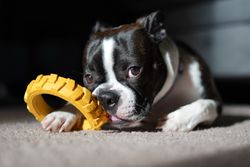
The timeline – when what happens
Teething follows a fairly reliable schedule, even if there are small variations from dog to dog. The milk teeth come through from an age of around three weeks. By the time the puppy is roughly eight weeks old – so usually about the point when it moves to its new home – the milk teeth are fully in. So when your puppy moves in with you, it will as a rule already have all its milk teeth.
Things get more interesting afterwards. The actual change to the permanent teeth begins at around four to six months of age. One by one the milk teeth loosen, fall out and make way for the 42 permanent teeth pushing up behind them. This process takes several weeks and is usually complete at around six to seven months. After that your dog has its final set of teeth, meant to accompany it through its whole life.

What you will notice during teething
In many puppies teething passes so unremarkably that the owners barely notice anything. Others show clearer signs. By far the most common is a pronounced urge to chew and gnaw: the puppy wants to chew on everything, because the pressure on the gums relieves the irritated spots. The gums can be sensitive, sore or itchy during this time.
You might spot a small drop of blood on a chew toy – usually harmless and part of the normal process when a milk tooth comes loose. Some puppies eat a little less for a day or two because chewing is uncomfortable. And every now and then you will actually find a tiny milk tooth on the floor or in the bed.
What surprises many people: often you see nothing of the shed teeth, because the puppy simply swallows them while eating. This is completely harmless – the little teeth pass through again without any problem. So you do not have to find every milk tooth for everything to be in order. What matters, though, is a different principle: never pull on a loose tooth yourself. Even if a milk tooth seems to be hanging by just a thread – let it fall out on its own. Pulling it yourself can injure the sensitive tooth root and hurt the puppy.
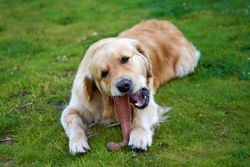
Helping the right way: offering sensible chewing
The strong urge to chew during teething is not disobedience but a genuine need. The best way to meet it is to offer your puppy suitable, safe chews – in the right size and not too hard. That gives the urge to gnaw a permitted outlet, and as a nice side effect you protect shoes, furniture and hands.
Many puppies find cool chews especially soothing: a chilled (not rock-hard frozen) chew toy or a special rubber toy can noticeably calm the irritated gums. If your puppy instead gnaws on your hand, your trouser leg or the sofa, calmly interrupt it and gently redirect it to a permitted chew. Telling it off achieves little here – patience and consistent redirection achieve a great deal.
An important safety note: keep away from very hard objects. Stones, hard bones, antlers or hard plastic may seem indestructible, but it is precisely on these that teeth – whether milk tooth or permanent tooth – can break off. A good chew gives a little under pressure. And finally, plain patience helps: the intense chewing phase is temporary and settles down as soon as the permanent set is complete.
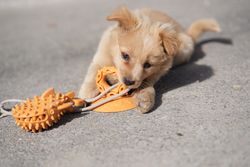
Now is the best time for dental care
Teething is not just a phase to get through – it is also a great opportunity. There is hardly a better time to get your dog used to dental care. Young dogs are curious and eager to learn, and what they come to know now as a matter of course, they accept for a lifetime.
Start very gently by regularly reaching into your puppy's mouth and briefly touching the teeth and gums – always combined with praise and a calm, positive mood. Once that has become a matter of course, gently introduce a dog toothbrush or a finger brush and a toothpaste for dogs. Human toothpaste is off-limits here. You can read how to build up tooth-brushing step by step in our guide to dental care.
Why is this effort worthwhile? Because it pays off twice over later. Regular tooth-brushing is the most effective way to prevent tartar and the gum inflammation it causes in the adult dog. Our article on tartar in dogs shows what good care helps to prevent and how tartar otherwise develops. Those who start now give their dog a real head start for its whole life.

When a milk tooth does not fall out: retained milk teeth
Normally the system is perfectly coordinated: the permanent tooth pushes up, the milk tooth loosens and falls out. Sometimes, though, a milk tooth stays put even though the permanent tooth is already coming through. Then for a short time you see two teeth side by side – a double tooth. Experts call this a retained milk tooth.
This happens most often with the canine teeth (the large fangs), and small dogs and toy breeds are especially affected. What looks harmless at first is a matter for the vet, for two reasons. First, the tooth that has stayed put can push the emerging permanent tooth in the wrong direction – resulting in a malocclusion, that is, teeth that do not meet correctly. Second, the two teeth stand so close together that food remnants and plaque lodge between them, which encourages inflammation.
That is why a double tooth should be checked by the vet. As a rule the retained milk tooth is removed. If the timing fits, this is often done during neutering, when the dog is already under anaesthetic anyway – you can find out more about that procedure in our guide to neutering your dog. If the tooth causes problems, it is pulled sooner too. And one more thing: if a milk tooth breaks off, an infection can get through the open site into the jaw and into the permanent tooth growing beneath it. So a broken-off milk tooth should be checked out as well. Our directory of vets shows you where to find a practice near you.
When you should see the vet
Teething is a natural process that usually goes well without any intervention. But there are some signs where you should have your young dog seen:
- a double row of teeth still present at around six months or later;
- a broken tooth;
- a visibly incorrect tooth position or a malocclusion;
- persistent mouth odour;
- a puppy that eats poorly for several days or stops eating altogether;
- bleeding that goes beyond a small drop.
When in doubt: better to ask once too early than to miss a problem. With a malocclusion and a retained milk tooth in particular, the right timing matters, because the position of the teeth can still be influenced while the jaw is growing.
Finally, the most important note: this guide offers general orientation and does not replace a veterinary examination. Your vet assesses your dog's teeth at the routine check-ups anyway – and is the right address as soon as you are unsure; through our directory of vets you will quickly find support near you. That way teething becomes exactly what it should be: a perfectly normal step into your dog's adult life.
Note: this guide offers general orientation and does not replace a veterinary examination or advice. If your dog has a health problem or in an emergency, please consult your vet.