Tartar in Dogs: How to Remove and Prevent It
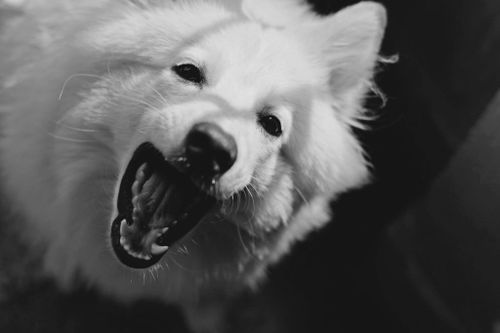
A cuddle with your own dog is one of the nicest everyday moments for many people – until their breath hits you. Bad breath is often the first thing owners notice when something is wrong with the teeth, and very often the cause behind the smell is tartar. Dental problems are among the most common health issues in dogs, and they often start at a young age – long before you even notice the first brown crusts. The good news first: with a little knowledge and a bit of routine, tartar can be effectively prevented, and once it is there, there is a clear, safe way to get rid of it again.
In this article, we take a calm look at how tartar forms, why it is far more than a cosmetic problem, how to prevent it with simple measures, and how professional removal at the vet works. If you want to go deeper into daily oral hygiene, our detailed guide to dental care for dogs is the perfect complement.
How Plaque Turns Into Tartar
At the beginning there is not the stone, but the film. A thin, soft dental plaque constantly forms on the teeth – a bacterial film simply known as plaque. It builds up continuously, day and night, and on its own it is still harmless: as long as it is removed regularly, it does no damage. But this is exactly where the crux lies. If the soft plaque is not brushed away, it mineralises within a few days and hardens. Plaque becomes tartar – a firm, rough crust that can no longer be removed by brushing alone.
What makes it especially insidious is where the tartar prefers to accumulate: not only on the visible tooth surfaces, but above all at and below the gum line, in the so-called gum pockets. This is the area you can barely see from the outside – and it is precisely there that the bacteria do the greatest damage. The rough surface of the tartar also gives new plaque even more to hold on to, so the problem reinforces itself: the more tartar there is, the faster new tartar forms.
Why Tartar Is More Than a Cosmetic Problem
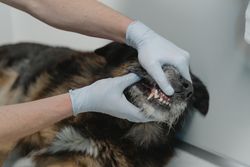
You might think a brown crust is mainly unsightly. But the real damage takes place below the gum line. The bacteria in the gum pockets irritate the gums, leading to gingivitis (inflammation of the gums): the gums turn red, swell and bleed easily. At this stage, much is still reversible.
If the inflammation goes untreated, it progresses to periodontitis – an inflammation that attacks the entire tooth-supporting structure, meaning everything that anchors the tooth in the jaw. Bit by bit, this tissue is destroyed: the teeth loosen, may fall out, and the dog suffers from chronic pain and infections in the mouth. This is no longer a cosmetic problem, but a painful disease.
On top of that, a persistent inflammation in the mouth can put a strain on the whole body – the organism is, so to speak, under chronic fire. Some dogs are particularly at risk: small breeds such as the Yorkshire Terrier, Maltese or Chihuahua tend to have deep gum pockets and not infrequently lose teeth early. For them, special attention pays off right from the start.
Prevention: Brushing Is the Most Effective Measure
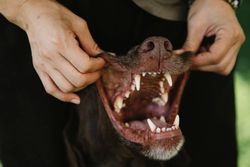
The most important message first: by far the most effective measure against tartar is regular, ideally daily tooth brushing. That sounds like a lot of effort, but it isn't once it has become a routine. For it you need a dog toothbrush or a finger brush and – very importantly – a toothpaste made for dogs.
Human toothpaste is off-limits. It can contain fluoride, which dogs should not swallow, and some varieties contain xylitol (birch sugar), which is toxic to dogs. Xylitol is one of the substances to keep away from your dog consistently – more on this in our overview of toxic foods. So always reach for the special dog toothpaste, which comes in flavours that dogs like.
The key to success is getting your dog used to it. Introduce brushing slowly and early, ideally as early as puppyhood, so that your dog experiences it as something natural and pleasant. Start with just a few seconds, praise generously and build up in small steps – you can read how to get your young dog used to routines like this from the start in our puppy checklist. Older dogs can still get used to it too, with patience. You will find the exact technique and lots of practical tips in our guide to dental care.
And what about chews and special food? Dental chews, chew items and special dental diets can support dental care – chewing mechanically helps to reduce plaque. But, and this is crucial: they do not replace brushing. They are a useful addition, not a substitute. If you are thinking about tooth-friendly feeding, our guide to dog nutrition will help. And finally, prevention includes a regular look inside the mouth – at home as well as during routine check-ups at the vet.
Once the Tartar Is There: Professional Removal
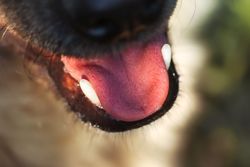
Once tartar has formed, no amount of brushing helps any more – the hard crust can no longer be removed at home. Now what is needed is a professional dental cleaning at the vet, and for good reason this is carried out under general anaesthesia.
The anaesthesia is not unnecessary effort, but the prerequisite for the work to be done properly. Only in a sleeping dog can the vet examine each individual tooth closely, measure the depth of the gum pockets with a probe and, if needed, take X-rays to see what lies hidden beneath the gums. Above all, though, it is the only way to clean the decisive area: below the gum line, where the harmful plaque does the greatest damage. Finally, the teeth are polished so that new plaque can adhere less easily. Our directory of vets shows you where to find a practice near you.
What to Make of Anaesthesia-Free Dental Cleaning
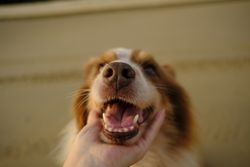
Time and again, an anaesthesia-free dental cleaning is offered that sounds tempting: no anaesthesia, no anaesthetic risk, often cheaper. But here a closer look pays off. With this method, only the visible tartar on the surface is removed – the teeth look cleaner afterwards. The effect, however, is mainly cosmetic.
That is because the actual problem is not solved: the harmful deposits below the gum line remain, and that is exactly where the cause of the inflammation sits. For many dogs the procedure is also stressful, because they have to hold still without sedation. And it can create a false sense of security: the mouth looks clean while, beneath the gums, the disease continues to spread undisturbed. An anaesthesia-free dental cleaning is therefore no substitute for proper dental treatment at the vet.
Warning Signs – and When to See the Vet
Because the most important things happen beneath the gums, it is worth knowing the visible warning signs. You should see the vet if you notice one or more of the following:
- Bad breath – an unpleasant smell is often the first sign.
- Yellow-brown crusts on the teeth.
- Red, swollen or bleeding gums.
- The dog eats less well, chews only on one side or drops food.
- Increased drooling or pawing at the mouth.
- Loose or missing teeth – a sign of an advanced stage.
A note especially on the last point: loose or falling teeth mean the disease is already well advanced – here the dog belongs at the practice promptly. As a general rule: better to have it checked once too early than to wait too long, because early treatment is gentler on the dog.
Many owners wonder what a professional dental cleaning costs. There is no blanket answer, because anaesthesia and treatment vary depending on the effort involved and the condition of the teeth. It is best to ask your practice for a cost estimate, so you know in advance where you stand. For a general overview of the expenses surrounding a dog, our article What a dog costs will help.
Staying On Top of It Pays Off
Tartar is not an inevitable fate. Those who start early, brush regularly and keep an eye on the teeth spare their dog a great deal – and themselves many an expensive and involved treatment. And if the tartar is there after all, professional removal at the vet is the safe way back to a healthy, pain-free mouth.
Finally, the most important sentence: this guide is general orientation and does not replace a veterinary examination. As soon as you are unsure or notice one of the warning signs, the vet is the right address – in our overview of vets and other services you will quickly find help near you.
Note: this guide offers general orientation and does not replace a veterinary examination or advice. If your dog has a health problem or in an emergency, please consult your vet.