German Shepherd: Temperament, Care and Health
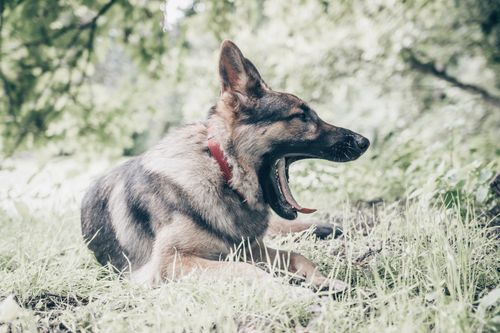
The German Shepherd is probably the best-known working dog in the world. As a police, rescue, assistance and family dog it has earned a legendary reputation. It is considered loyal, clever, hard-working and versatile, but it is anything but an undemanding beginner's dog for the side.
This portrait shows where the German Shepherd comes from, what defines it, what differences exist between the lines and what to watch for in terms of exercise and health. The compact breed data is also in the Rassen-Wiki entry on the German Shepherd.
Origin and history
The German Shepherd goes back to the end of the 19th century, when cavalry captain Max von Stephanitz deliberately shaped a capable, hard-working herding dog. From the original herding dogs a versatile service and working dog quickly emerged that made a career worldwide.
From the start, working ability was in the foreground. It is precisely this heritage that explains, to this day, the enormous willingness to learn, the protective instinct and the desire to work with people. The German Shepherd is a dog that needs a task and a clear reference person.
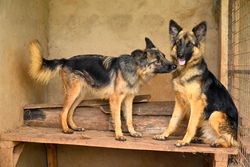
Appearance and the two lines
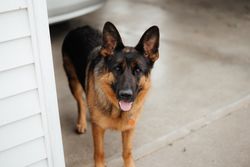
The German Shepherd is a large, powerful dog with a shoulder height of about 55 to 65 centimetres and a weight of around 22 to 40 kilograms. It comes with a standard coat and with a long coat, classically black and tan, but also in other colourings.
Important is the difference between working and show lines. Working lines are usually more athletic, more drivey and straighter in the back. Some show lines have been bred with a strongly sloping back line, which is viewed critically from an animal-welfare perspective. Look for a healthy, straight-built dog.
Temperament and character
The German Shepherd is intelligent, loyal, watchful and very willing to work. With its reference person it builds a close bond and is ready to learn a lot. It is by nature attentive and protects what is entrusted to it, without being excessively sharp under good leadership.
This protective instinct and sensitivity demand a self-assured, fair owner. A poorly led or under-challenged Shepherd can become insecure, nervous or excessively suspicious. Early imprinting and good socialisation are therefore especially important.
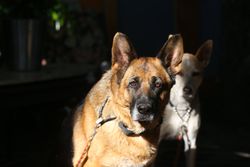
Who is the German Shepherd right for?
The German Shepherd suits active, reliable people who offer it leadership, time and a task. It is a great partner for dog sport, tracking or structured occupation and can, well trained, also be a wonderful family dog.
It suits less well people without time or experience looking for a low-maintenance dog on the side. Its protective instinct, size and need for occupation want to be taken seriously. Without consistent, friendly leadership it will organise itself.
Exercise and training
The German Shepherd needs physical movement and above all mental work. It loves solving tasks together with its person, whether in training, dog sport or nose work. Mental work often exercises it more lastingly than plain running.
In training it is rewarding and learns fast, but reacts sensitively to unfairness. Positive reinforcement, clarity and consistency lead to the goal. The basics of building signals are in the guide to dog training. During growth, the joints of the large dog must be spared.
Everyday care
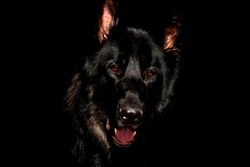
The German Shepherd famously sheds heavily, which is why it is jokingly called the perpetual shedder. Regular brushing, daily during the moult, keeps the dead undercoat in check. The long coat needs a bit more attention at the feathering, see the guide to coat care.
Also think of nails, teeth, ears and paws as a fixed part of the care routine. Anyone who gets the dog used to handling early and kindly makes care and vet visits considerably easier and fosters trust along the way.
Health and typical illnesses
The German Shepherd is unfortunately known for some breed-typical problems, above all hip and elbow dysplasia. Degenerative myelopathy, a progressive spinal cord disease, also occurs. As a large, deep-chested dog it is additionally prone to the life-threatening gastric torsion.
What you need to know about this emergency is explained in the guide to gastric torsion. Look for serious breeding with joint and health examinations, keep the dog lean and go to the vet early with any abnormalities. A look at dog insurance is worthwhile.
Getting one in Switzerland
A puppy from a serious breeder costs in Switzerland, depending on the line, about 1500 to 2800 francs. Consider beforehand whether you want a calmer show line or a drivey working line, and choose a breeding operation with healthy, straight-built parent animals and complete examinations.
Avoid puppy mills and extreme breeding forms. Registration in the dog database is mandatory, see the guide on AMICUS. What a puppy needs at the start is summarised in the puppy starter kit.
Conclusion: is the German Shepherd right for you?
The German Shepherd is an impressively versatile, loyal and eager-to-learn dog for people who can offer leadership, time and a task. In the right hands it is a reliable partner for everyday life, sport and family.
Anyone who, by contrast, cannot give it structure, occupation and clear leadership does justice neither to the dog nor to themselves. For this breed, pay particular attention to healthy breeding lines, because health should always come before looks.
Frequently asked questions
Is the German Shepherd a family dog? Yes, with good training and socialisation it can be a wonderful family dog. But it needs leadership, occupation and respectful handling, especially with children.
What is the difference between working and show line? Working lines are usually more athletic and drivey with a straight back, some show lines have a sloping back line. Look for a healthy, straight-built dog.
Does the German Shepherd shed a lot? Yes, it sheds heavily, especially during the moult. Regular brushing is a must to keep the dead undercoat in check.
Is it a beginner's dog? Rather not. Its protective instinct, size and need for occupation demand a self-assured, consistent owner with time.
Note: this guide offers general orientation and does not replace a veterinary examination or advice. If your dog has a health problem or in an emergency, please consult your vet.