Dog Training: The Basics for Puppies & Adult Dogs
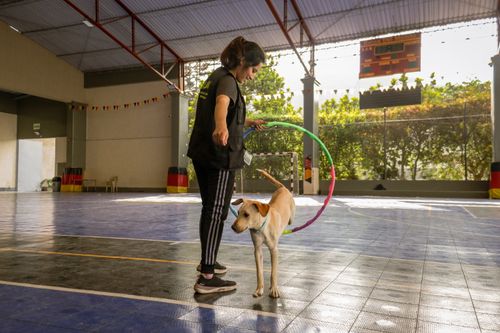
A dog doesn't arrive with an instruction manual – and certainly not knowing how life at our side is supposed to work. He doesn't understand our language, doesn't know our rules and, at first, has no idea what a sofa, a pedestrian crossing or a vacuum cleaner mean for him. Training is really nothing more than patient translation between two species that want to live together. It isn't drill or a battle over rank, but a shared language the two of you build up step by step.
The good news: this language can be learned – by the eight-week-old puppy just as much as by the adult dog who already has a whole life behind him. Once you understand the basics, you spare yourself much frustration and lay the foundation for a relaxed life together.
Training Is Communication, Not Drill
The days of raising dogs with harshness, a loud commanding tone and the famous "he has to learn his place" are over – and for good reason. Experts today agree: a dog learns best and most lastingly through positive reinforcement. This means you reward the behaviour you want to see, and the dog repeats it because it pays off for him. Punishment, intimidation and pain are not just outdated, they are counterproductive: they create fear, destroy trust and can even encourage aggression.
In Switzerland this principle is even enshrined in law. Training aids that cause a dog pain or fear – prong collars, choke collars, spray collars and electric collars – are expressly banned under the Animal Welfare Ordinance (TSchV, Article 76). Training should be non-violent and reward-based, full stop. Anyone who believes a barking or pulling dog can only be controlled with such devices is mistaken: for unwanted behaviour like excessive barking there are fairer, more effective ways, which we describe in our article on barking.
The Imprinting Period: The Most Important Window
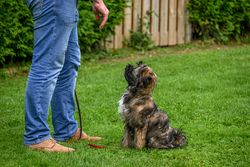
When you bring a puppy home, you hold a small miracle in your hands – and, at the same time, a great responsibility. In the first months of life a window stands wide open that will never open in quite the same way again. During what is known as the imprinting and socialisation phase, roughly between the third and the sixteenth week of life, the young dog learns with astonishing ease what is normal and harmless in his world.
Everything the puppy gets to know calmly and positively during this time stays with him for life: different people, children, other dogs and animals, all kinds of sounds, surfaces such as metal grates or gravel, traffic on the road, car rides and being touched on his paws, ears and muzzle. The aim is not to flood the puppy with stimuli, but to accustom him to the world gently and in small doses – always so that he gathers positive experiences and is never overwhelmed.
Sounds are part of this habituation, too. A puppy who takes everyday noise in his stride will have an easier time later on – especially with loud events like fireworks, which he should be introduced to early and gently. You can read how to manage this in our guide to sound habituation. In parallel, house-training begins, which – with patience and fixed routines – usually works faster than many fear; you will find the key steps in our guide to house-training. For a complete overview of the first weeks with your little one, see our puppy checklist.
A wonderful place to practise all of this is a good puppy play session. There, under expert guidance, your dog meets others of his own kind, learns bite inhibition and social behaviour, and you pick up your first exercises. You will find a suitable dog school near you in our directory.
The Golden Rules of Practice
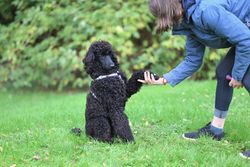
Whether puppy or adult dog – good training always follows the same principles. Take them to heart and you reach your goal faster, with fewer misunderstandings. The most important rules are:
- Consistency: what is allowed today must still apply tomorrow. If the dog is allowed on the sofa one day and not the next, the world stops making sense to him.
- Everyone pulls in the same direction: the whole household should use the same signals and the same rules. If one person says "sit" and another "sit down now", it gets hard for the dog.
- Short and frequent: several short sessions of just a few minutes achieve more than one long, tiring training hour.
- Timing: the reward has to come at the right moment – ideally in the very second the dog does the right thing.
- Always end on a positive note: finish every session with an exercise that succeeds. That keeps the joy of learning alive.
On top of that comes a principle many people underestimate: management. This means not letting unwanted behaviour arise in the first place. A bin that is safely stowed away can't be raided; a puppy who gets outside in good time doesn't leave a puddle. By avoiding the opportunity for mistakes while rewarding the desired behaviour, you spare both yourself and your dog endless correcting. And don't forget the most important ingredient: patience. Setbacks are part of the process, and anger has no place in training.
The Most Important Basic Cues
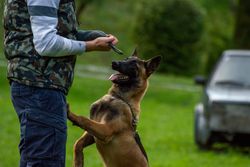
A few reliable cues make everyday life with a dog enormously easier and are, at the same time, the basis for everything else. Every dog should master these basics:
- His own name and attention: the dog learns to turn towards you as soon as you speak to him.
- Sit: the first and simplest cue, ideal for getting started.
- Down: lying down and settling.
- Stay: waiting in place until the cue to move on is given.
- Recall (Come): perhaps the single most important cue of all – coming back reliably can save a life.
- Leash walking: walking on a loose leash without pulling.
Build these cues up in small steps and practise them first where it is quiet with few distractions. Only once your dog reliably masters an exercise do you slowly increase the difficulty – for example in the garden, then in the park, and finally with other dogs nearby. This is especially true for the recall: always make coming back the best decision of the day, with lavish praise and a fantastic reward. Never call your dog only to scold him afterwards – otherwise he learns that coming isn't worth it.
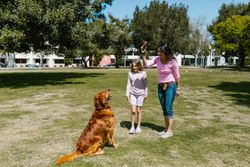
Training Happens in Everyday Life
The biggest mistake would be to limit training to practice sessions. In reality your dog learns every waking minute: every time he pulls on the leash and gets ahead faster because of it, and every time begging at the table is rewarded with a titbit, a behaviour is reinforced. So make deliberate use of the many small opportunities of the day – have the dog do a quick "sit" before his meal, practise the recall playfully in the garden, reward calm behaviour when visitors arrive. A relaxed dog's life also includes being able to stay alone without panicking; that can be trained, and we show you how in our guide Dog home alone.
Adult Dogs Can Still Learn, Too
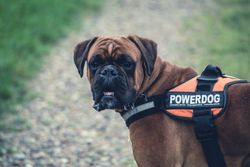
The old saying that you can't teach an old dog new tricks is simply wrong. Dogs learn their whole lives long – adult and even elderly animals just as much as puppies. A dog from a shelter or a previous home may bring gaps or old habits with him, but with patience, consistency and the same positive methods you can make up an astonishing amount of ground. Sometimes it is even easier, because adult dogs are calmer and more attentive than a fidgety puppy.
One thing you shouldn't forget: every dog is an individual, and breed helps shape temperament, eagerness to learn and needs. A herding dog wants to work and think along; an easy-going companion dog ticks differently from a spirited hunting dog. Knowing your dog's disposition lets you tailor the training more suitably. In our breed wiki you will find the typical traits of many breeds, and anyone still deciding on a dog can get a feel for which type suits their life with our breed-finder quiz.
When a Dog School Helps – and What Applies in Switzerland
Many people wonder whether a dog school is compulsory. For Switzerland, the answer at federal level is no. The compulsory certificate of competence (SKN) introduced in 2008 was abolished again in 2017 – since then there has been neither a compulsory dog school nor a mandatory course nationally. Responsibility today lies with the cantons, and individual cantons may well impose their own course or training requirements. To find out what applies where you live, check directly with your canton and municipality. You will find further contact points and services in your region in our services overview.
Compulsory or not – a good dog school is almost always a worthwhile investment. It helps you avoid mistakes, gives you confidence in handling your dog and offers him valuable social contact. Look for a school that works non-violently and with positive reinforcement – in other words, exactly the method this guide is about. You will find a dog school near you in our directory.
In the end, dog training is not a question of strictness or talent, but of relationship. Meet your dog with patience, clarity and kindness and you get a partner who is happy to join in – and that is the finest goal of any training.