Dog Home Alone: Preventing Separation Anxiety
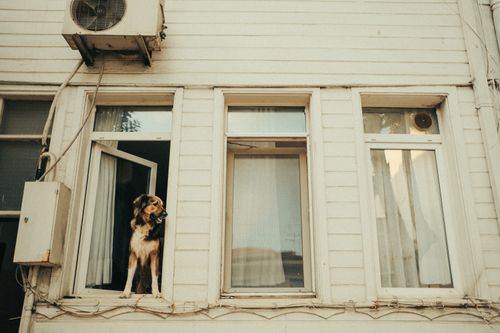
A dog that can stay home alone in a relaxed way is a relaxed dog – and you are a freer person. You can go to work, do the shopping or eat out with friends without your dog falling into a panic and without you sneaking out of the flat with a guilty conscience. The best part: being left alone isn't a character trait a dog simply has or doesn't. It's a skill he can learn – in small steps, at his own pace, with you as a calm anchor. Most problems only arise because we ask too much of the dog at once. Anyone who takes a bit of time at the start saves themselves a lot of stress later – on both sides of the front door.
Why being alone has to be learned
Dogs are social animals through and through. They like company, they rest most happily near their people, and they feel safest in the group. Being on their own is therefore nothing they take for granted – it's something a dog first has to learn. And this is where the biggest misunderstanding lies: we often expect a dog to stay alone for eight hours without complaint from one day to the next, simply because our daily life demands it. From the dog's point of view that's plainly too much – you can't start from zero and jump straight to a whole working day.
This is especially delicate with a puppy or a newly arrived dog. He has just landed in a completely new environment, has lost his familiar group and first has to build trust. Leaving him alone for hours now is the worst possible start. Conversely: the calmer and more positive the first experiences are, the more matter-of-course the whole thing becomes for him later.
Step by step to relaxed time alone
The build-up follows a simple principle: tiny steps, and always with a calm dog. You don't start with minutes, but with seconds. Sounds exaggerated, but that's exactly why it works.
- Start small: take one step out of the door and come straight back in while your dog is still completely relaxed.
- Increase slowly: first a few seconds, then a minute, then several – always just a little bit more.
- Come back while he's calm: never only once he's already whining or scratching at the door. You want to reward the calm moment, not the agitation.
- Only extend once the previous step is solid: if your dog stays relaxed at five minutes, you go to ten. Not before.
- Build in variety: practise at different times of day and not always in the same sequence, so that "door closes" doesn't automatically come to mean "now comes an eternity".
The path is rarely dead straight: sometimes a step works at once, sometimes you have to go one back. If your dog becomes restless, you went too fast – then drop down a level and build up again from there. A dog who has learned that you always come back and that nothing bad ever happens while you're away develops exactly the composure you're hoping for.
Coming and going without a big drama
For us humans the goodbye is a moment full of feeling: one more kiss, one more "I'll be back really soon", one more worried glance back. It's precisely this drama that makes being alone harder for the dog – it builds tension and marks your leaving as something big. So keep goodbye and return deliberately unspectacular. Leave without comment or with a casual word, and when you come back, greet your dog calmly instead of throwing a celebration. Wait until he's settled, and then say hello. That way the difference between "you're here" and "you're gone" stays nice and small – and the smaller that contrast, the easier the waiting.
A simple but powerful trick helps on top of this: give your dog something really good at the exact moment you leave – and only then. A long-lasting chew or a well-filled food toy (a stuffed Kong, for example) is perfect. This highlight appears only when you leave and disappears the moment you're back. That way your disappearing gradually links up with something nice, and the first, hardest minutes are meaningfully bridged.
A tired dog would rather stay alone
Before you go, a proper walk pays off. A dog that has moved, sniffed and strained his head a little rests far more happily afterwards than one almost bursting with energy. Keeping him occupied doesn't only mean running: nose work, a few search games, practising together or a good long chew often tire a dog out more than a long walk. A contented, pleasantly tired dog lies down and, ideally, sleeps through most of your absence. But plan the active time a little earlier and let the last half-hour before you set off wind down calmly – that way your dog glides straight from rest mode into being alone.
Boredom or genuine separation anxiety?
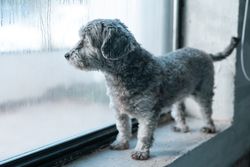
Not every mishap in the flat is separation anxiety. An under-challenged dog who is simply bored might gnaw on a shoe or bark now and then – that's annoying, but it's something other than genuine distress. Separation anxiety is panic, and it usually shows clearly. These are the signs you should know:
- persistent barking, whining or howling, often just after you've closed the door
- destruction, especially at doors and windows – that is, exactly where the dog wants to get out to you
- soiling, even though your dog is actually house-trained
- heavy salivating or drooling
- restless pacing back and forth, a constant up and down
- refusing food – the wonderful chew stays untouched, because the dog is too stressed to get a bite down
What matters is the attitude behind it: this is not defiance and not revenge. Your dog isn't scratching the door to get back at you – he's desperate and trying to reach you. That's what distinguishes genuine fear from mere boredom: it often sets in within the first few minutes after you leave and is panic, not under-occupation. Anyone who sees these signals doesn't simply let the dog keep "toughing out" being alone, but calmly takes a step back.
Why punishment makes everything worse
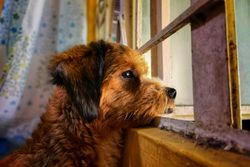
Many know the scene: you come home, there's a little heap or a shredded cushion in the corner, and the dog makes himself small and looks "guilty". But that look is no admission of guilt: your dog reads your tension and reacts to what he sees in you right now. He can't link your annoyance to something that happened an hour ago. Telling him off therefore does nothing but harm – your return, which should really be the safe moment, itself becomes a threat, and with that the fear grows instead of shrinking.
The reward-based path turns this around: coming and going stay calm and boring, relaxed behaviour is confirmed, and mistakes aren't punished but avoided through smaller steps. And if you want to know what really happens while you're away, a simple trick helps: set up a phone or an old smartphone as a camera and film the first half-hour. Does your dog settle after two minutes and curl up? Or does he pace restlessly and bark the moment the door is shut? These images show you whether it's boredom or genuine fear – and whether your training is heading in the right direction.
How long is fair – and what to do if you work?
A rough rule of thumb: an adult dog shouldn't regularly stay alone much longer than about four to six hours. That's not a stopwatch rule – some dogs cope with more, many prefer less, and it always holds that the dog was outside beforehand and could relieve himself. For puppies the span is considerably shorter: the bladder and nerves of a young dog aren't ready for long stretches yet, and he needs someone at his side far more often. A single longer day won't rattle a settled dog – the problem is the daily block of eight hours or more.
If your working day is longer, there are good solutions:
- a dog walker who takes your dog out for a round at midday
- a doggy day care for the days you're in the office
- neighbours, family or a walking service who reliably step in
- consciously used working-from-home days, so that not every week looks the same
You'll find suitable dog schools, day-care centres and care options in your canton in our service overview. Getting support is nothing to be ashamed of – on the contrary, it's fair to your dog.
When to get help
Some cases belong in expert hands. If your dog panics every single time, injures himself trying to escape, keeps destroying or soiling despite careful training, or if the camera shows genuine, lasting distress, then don't wait any longer. A vet first rules out physical causes and, together with a good behaviour adviser, sets up a plan. Good to know: the calm, step-by-step path is the same one that also helps with noise fear – for example fear of fireworks.
And there's one stubborn myth we want to clear up: comforting a frightened dog does not "cause" separation anxiety. You can't spoil your dog into fear. Fear is an emotion, not a trained trick – if your calm presence helps him, then give it to him. Separation anxiety arises from being overwhelmed, not from too much affection. With patience, small steps and a positive basic mood, the vast majority of dogs learn to stay calmly alone.
More support for everyday life with a dog: dog schools, day-care centres and services in your canton, our checklist for puppies with the right start into time alone – and for anxious dogs the guide fear of fireworks, which relies on the same calm, step-by-step method.