Getting House-Trained: How to Manage It with Your Puppy
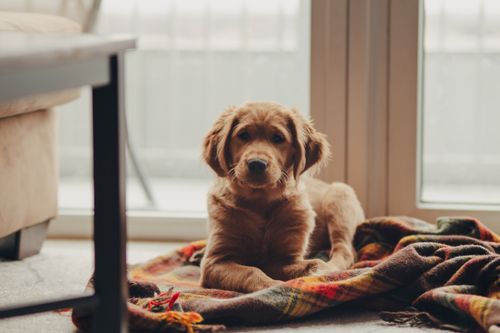
First the reassuring part: whether your puppy becomes house-trained quickly has little to do with his intelligence and even less with any supposed stubbornness. Above all it depends on your timing. A small dog simply can't help relieving himself when his bladder is pressing – and your job is to already be outside in exactly those moments. Once you've grasped that, you take the whole thing much more calmly. A puddle isn't cheek, it's simply a missed moment.
House-training is therefore less about drill than about good organisation. You build a routine, you learn to read your puppy, and you are generous with praise. Punishment has no place in this process – it only makes everything harder, as you'll see in a moment. Resolve to take the coming weeks with humour, to keep a cloth and a good cleaner within reach, and to celebrate every little success.
Why a puppy can't hold it yet
A young puppy has a tiny bladder and hardly any control over the muscles that govern urinating. He often only notices at the very last moment that the time has come – and then it has to happen right away. That's not bad manners, it's simply biology. Which is precisely why the most important principle is: better one trip outside too many than one too few.
As the weeks go by the bladder grows, control gets better, and the intervals between toilet trips are allowed to grow longer. But at the start it holds true: your puppy can't wait until it happens to suit you. He needs you as a forward-thinking partner who creates the opportunity before the mishap happens.
The routine: when to go outside
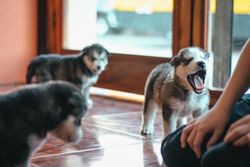
The heart of house-training is a reliable routine. There are a few moments when a puppy will almost certainly need to go – you can memorise them like a little programme:
- Right after waking up – in the morning just as much as after every daytime nap
- After eating – a full tummy gets the digestion going
- After playing and after any excitement
- Roughly every one to two hours in between, even when apparently nothing is going on
- First thing in the morning and last thing before the night
Sounds like a lot of running back and forth? It is, for a few weeks. But it's precisely this consistency at the start that shortens the whole learning phase. It's best to always go out yourself rather than just sending the puppy into the garden – only that way are you there at the right moment and can reward (more on that shortly). A little note on the fridge where you jot down the times helps surprisingly well in the first days to get a feel for your dog's rhythm.
Always the same spot – and praise at the right moment
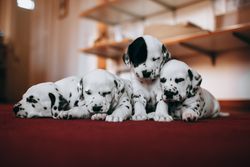
Choose a fixed spot outside and keep taking your puppy back to it. His own scent, which sticks there over time, tells the dog: this is the right place. Stand calmly beside him, don't say much and simply wait. Sometimes it takes a little while – patience.
And now comes the most important point of all: the second your puppy has finished outside, you reward him immediately. A cheerful word of praise, a treat, a quick stroke – right there where he relieved himself. Not indoors, not three minutes later. A puppy only links the reward with what he is doing in that very instant. If you praise him only in the kitchen, in his eyes you're celebrating the coming back, not the business in the grass. This perfect timing is the real trick to the whole thing.
Many people additionally use a quiet signal word that they say again and again while he's relieving himself. Over time the dog understands it as a prompt – handy when it later has to happen quickly.
Reading the little signals
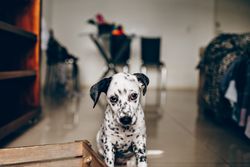
Puppies announce that they need to go – you just have to watch. Look out for these early signs:
- sudden sniffing at the floor, as if searching for something
- turning in circles or restless to-ing and fro-ing
- an abrupt break from play or activity
- purposefully heading for a corner or sneaking out of the room
If you see one of these signs, it means: right now. Calmly pick the puppy up or coax him quickly to the door and off outside to the familiar spot. With a bit of practice you'll spot the signals ever earlier – and at some point your dog will walk to the door by himself when he needs to. That's exactly when you know it's clicking.
Why telling him off backfires
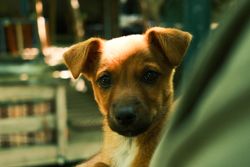
A puddle happens anyway – quite certainly, in fact, again and again. And now the single most important thing: don't tell him off. Punishment doesn't teach a puppy where he should go. It teaches him to be afraid of you and, next time, to prefer to hide – behind the sofa, in another room. A dog who has learned that relieving himself near you is dangerous doesn't get cleaner, just sneakier. With that you've achieved the opposite of what you wanted.
If you catch him in the act, at most you interrupt very calmly and take him outside to reward the right behaviour there. If the mishap has already happened, there's only one thing to do: wipe it up without comment. He won't understand an after-the-fact connection anyway.
When cleaning, the right product matters. Use an enzyme cleaner, not an ordinary household cleaner. Only the enzymes really break down the odour compounds in the urine. To our nose both smell clean afterwards – but the fine canine nose easily finds a spot treated with a normal cleaner again and reads it as an invitation to go in exactly the same place once more. A good enzyme cleaner closes off this invisible scent trail.
Management: crate and small area – with heart
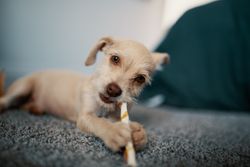
You can't keep an eye on your puppy around the clock – and that's exactly when most accidents happen. For the moments when you're cooking, showering or briefly away, good management helps. A suitably sized crate or a small, puppy-safe area makes use of a natural instinct: dogs avoid soiling their own sleeping place. In a manageable, cosy space your puppy is more likely to let you know rather than simply letting go.
One thing is crucial here: the crate is a friendly retreat, not a prison. It has to be big enough for the dog to stand comfortably, turn around and lie stretched out, and you build it up positively with treats and calm. It is never a long-stay parking spot for hours. A puppy who is shut in and needs to go anyway gets into a real conflict – and in the end loses the very instinct we're relying on. Short, friendly, with breaks in the fresh air: that's how the crate becomes a helper instead of a problem.
The night and a big helping of patience
At night the same rules apply, just sleepier. Don't offer a big portion of food or a large amount of water right before bed, and take one last round to relieve himself immediately before the night. Even so, with a very young puppy there will be the odd night that means: get up, quick trip out, back to bed. That passes as soon as the bladder grows bigger.
And now the most honest sentence in this guide: it takes time. Mishaps are completely normal for weeks. Many dogs are reliably house-trained only at around four to six months, some a little later – each at his own pace. Don't measure your progress by individual bad days. A setback after a good week doesn't mean it was all for nothing; it's simply part of the process.
By the way, it's not only puppies who go through this phase. An adult dog from a rescue, getting to know a new home, or a flat for the very first time, often needs exactly the same routine as a puppy – as a clean fresh start. Treat him for the first few weeks as if he were learning everything anew, and most get the hang of it quickly.
It clicks – and then it stays
The path to house-training is rarely a straight line. It goes uphill, then a small step back, then several dry days in a row again. And then, often quite undramatically, you notice one day that the puddles have stopped and your dog is standing at the door by himself. What has once settled in properly usually stays for the rest of the dog's life.
So stick with it, stay friendly and celebrate the progress. If you'd like support along the way, our overview of dog schools and vets will help you find the right people near you. How to handle the whole first period with your young dog well, you can read in our big puppy guide – and because relaxed time alone goes hand in hand with a calm, clean everyday life, that's worth a look too. You've got this – and so has your puppy.