Dog insurance in Switzerland: worth it or not?

The question comes up with almost every new dog: do I need insurance – and if so, which one? Some pay premiums for years and never use them. Others are left with a bill of several thousand francs after an accident and wish they had made provision. There is no blanket answer, but there is an honest one. And that is exactly what you get here – with no sales pitch, because we recommend no product to you and earn nothing on your choice.
First the most important thing: dog insurance is not a single product. Behind it lie two completely different things that constantly get mixed up. Anyone who separates the two cleanly already makes a much better decision.
Two insurances that often get confused
There is dog liability insurance and animal health or health insurance. They solve two completely different problems.
Liability insurance steps in when your dog causes damage to others. It bites another dog, jumps up at a jogger who falls and gets hurt, chews up the sofa in the rented flat or runs onto the road and causes a traffic accident. In such cases you are liable – and the sums can quickly become large, especially with personal injury. That is exactly why this insurance exists.
Health insurance turns the direction around: it pays your vet bills when the dog itself gets ill or has an accident. Operations, diagnostics, medication – that is what it is there for. Often an accident or surgery component is included.
In short: liability insurance protects others (and you from their claims), health insurance protects your dog and your budget. One does not replace the other.

Liability: sometimes compulsory, always sensible
Whether you have to have dog liability insurance depends on the canton. There is no uniform rule for the whole of Switzerland. In many cantons it is mandatory – these include, among others, Zürich, Bern, Basel-Stadt, St. Gallen, Thurgau, Tessin and Genf, and several more. The exact list and the required minimum sums differ from canton to canton and change over time. Some cantons prescribe cover in the millions.
That is why the most important advice in this section: check what actually applies in your canton – and when you move, check again in the new one. Do not rely on what an acquaintance tells you.
And even where there is no obligation: liability insurance for the dog is cheap and, when it matters, worth its weight in gold. A single serious case of personal injury could otherwise keep you busy for a long time. Sometimes the dog is even already covered by your private liability insurance. But do not simply rely on that – read up or ask specifically whether dogs are included and whether the sum insured is high enough. Neither is a given.
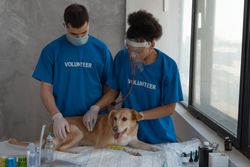
Health insurance: what it covers
Animal health insurance covers the costs when your dog gets ill or has an accident – from the examination through the operation to medication and often the diagnostics too. Sounds simple, but this is exactly the point where the small print counts. Two policies that sound almost the same can differ greatly.
So that you get an idea of what this is even about: veterinary care in Switzerland is excellent, but the prices are not state-regulated and are correspondingly high. The running costs for a dog come to roughly 1,000 to 2,000 francs a year – and that is normal operation. A single serious case easily blows past that: a cruciate ligament operation, for example, can cost several thousand francs. Even so, to this day only about one in seven dogs in Switzerland is insured at all, so around 15 percent – but the market is growing markedly.

The small print that makes the difference
Before you take out health insurance, you should have understood these four terms:
- Deductible: the share of each bill you bear yourself. Sometimes a fixed amount, sometimes a percentage – the lower the deductible, the higher the premium usually is.
- Annual limit: many policies only pay up to a maximum amount per year. With some providers this ceiling is around 10,000 francs a year. Anything above that you pay yourself.
- Waiting period: after signing the contract, a certain time often passes before the cover kicks in. Anyone who only rushes to the insurer once the dog is already limping is too late.
- Pre-existing conditions: illnesses the dog already had before the contract began are generally excluded. That is why it pays to sign up early.
On top of that come age and breed. The premium depends mainly on breed, age and the chosen scope of cover. You do best when you insure a young, healthy dog. With older dogs some insurers charge a surcharge or no longer take them on at all. So anyone thinking about health insurance is better off deciding early in the dog's life than late.

What does it cost – and what drives the price?
There is no single, universally valid premium; dogs and policies are simply too different for that. As a rough guide: comprehensive health cover for a medium-sized dog moves, in current Swiss offers, in the order of around 80 to 160 francs a month. Simpler cover or pure accident protection is cheaper.
What pushes the price up or down:
- Breed: larger dogs and breeds with known health issues usually cost more.
- Age: the younger at sign-up, the lower the premium – and the more likely you will be accepted at all.
- Scope of cover: full cover with a low deductible and a high annual limit costs more than a lean policy.
Liability insurance is a small item by comparison – it costs only a fraction of that and is therefore almost always an easy decision.

Insure or rather save yourself?
There is an honest alternative to health insurance: making provision yourself. Instead of paying premiums, you put a fixed amount into a separate savings account every month – and only touch it for the dog. This is basically an insurance in which you yourself are the insurer.
The approach works if two things are true: you are genuinely disciplined, and your dog stays reasonably healthy, so the cushion can grow. It fails when a big case strikes early – when the dog needs an expensive operation at two years old and there are only a few hundred francs in the account. Health insurance takes exactly this risk off your hands, but in return costs money every month, even if nothing ever happens.
A pragmatic middle way that many choose: always take out liability insurance (cheap, covers the big risk towards others) and weigh up honestly on health cover – or at least save consistently if you decide against a policy.
How to choose – a short checklist
- First clarify liability: is it compulsory in your canton? And is the dog perhaps already included in your private liability cover – with a sufficiently high sum?
- Think honestly about how you would react to an unexpected bill of several thousand francs. Your answer tells you whether you need health cover.
- Compare not just the premium, but also the deductible, annual limit and waiting period – that is where the real differences lie.
- Sign up early, while the dog is young and healthy, to avoid exclusions and surcharges.
- Read what applies to pre-existing conditions before you sign.
A few names, so you know where you can even look – without any rating and without a test winner: active on the market are, among others, Animalia and Epona (both part of the Vaudoise group), the wau-miau product from Helvetia, AGRIA and Calingo; AXA, Zurich and Swica also offer cover. For a neutral overview, comparison services like comparis.ch and moneyland.ch are useful. Which provider suits you depends on your dog and your priorities – not on a ranking.
The bottom line
Quite soberly: liability insurance is the right choice for almost every dog owner – in some places it is compulsory anyway, everywhere it is cheap, and it protects you from the risk that could really hit you financially. With health insurance the answer is more personal. It is worth it above all if you have a young dog, a larger vet bill would blow your budget and you want to sleep soundly. Anyone who, on the other hand, has a solid financial cushion and saves with discipline can also do well without.
The worst option is not to think about it at all – neither to sign up nor to save. Make a conscious decision, and make it early in the dog's life. Your future self and your dog will thank you for it.
You will find more on the cantonal regulations on our pages about dog law, and if you are looking for a vet practice or other points of contact, our overview of services will help. How much a dog costs in total – including taxes and running expenses – you can read in the article dog tax and costs.