Cavalier King Charles Spaniel: Temperament and Health

The Cavalier King Charles Spaniel is the epitome of the gentle companion dog: small, silky, friendly and very cuddly. Few breeds seek human closeness as much. It is a wonderful family and companion dog, but for few breeds is the choice of a truly health-conscious breeder as decisive.
This portrait shows where the Cavalier comes from, what defines it, who it suits and, quite honestly, which serious health topics you must know about. The compact breed data is also in the Rassen-Wiki entry on the Cavalier King Charles Spaniel.
Origin and history
The Cavalier King Charles Spaniel goes back to the small spaniels popular at European royal courts as lap and companion dogs, especially at the English court under King Charles II. From the start it was not a working dog, but a pure companion dog.
The modern breed was re-bred in the 20th century towards the original, longer muzzle to preserve the old type. This history as a courtly lapdog shapes its gentle, people-oriented nature to this day. For centuries the Cavalier was bred solely to be a pleasant, devoted companion, and that is its great strength to this day.
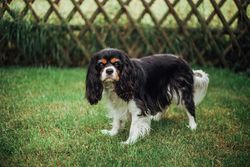
Appearance: size, weight and coat
The Cavalier is a small, elegantly built dog with a shoulder height of about 30 to 33 centimetres and a weight of around 5 to 8 kilograms. Typical are the large, dark eyes with a gentle expression and the long, well-feathered ears.
The coat is medium-length, silky and slightly wavy, with feathering on ears, legs and tail, in several classic colours. It needs regular care so it does not mat, especially behind the ears. More on this in the guide to coat care.

Temperament and character
The Cavalier is gentle, friendly, adaptable and extremely people-oriented. It loves company, cuddles for its life and usually gets on very well with children, other dogs and even cats. Aggression is foreign to it, which is why it is completely unsuitable as a guard dog.
This attachment has a downside: the Cavalier tolerates being alone a lot poorly and then tends towards distress. It adapts to the pace of its people, calm or active. Good socialisation makes it an uncomplicated companion.

Who is the Cavalier right for?
The Cavalier King Charles Spaniel is an ideal companion dog for families, couples, seniors and anyone looking for an affectionate, uncomplicated dog that likes to be part of things. Its exercise needs are moderate, a few walks and some play suffice, even though it likes to hike along for longer.
The key is that someone spends a lot of time with it, because being alone makes it unhappy. Just as important is the willingness to engage with the breed's health risks and to choose a responsible breeder.

Everyday care
The silky coat needs regular brushing, several times a week, to prevent matting, especially at the long ears and the feathering. Check the drop ears regularly for dirt and inflammation, as they are poorly ventilated.
Also think of eyes, nails, teeth and paws in the care routine. Because small breeds tend towards tartar, dental care is important, see the guide on tartar. Overall, though, the Cavalier remains easy to handle and patiently puts up with most grooming steps, which makes care and vet visits pleasant.

Health: the honest truth
Here is the most important part of this portrait. The Cavalier is unfortunately heavily affected by two serious diseases. Mitral valve disease, a heart condition, occurs frequently in the breed and often already at a young age. Added to this is syringomyelia, a painful neurological disease in which the skull is too small for the brain.
These problems are widespread due to the breed, which is why health-conscious breeding with heart examinations of the parent animals and, where possible, further examinations is absolutely decisive. Alongside, eye, ear and patella problems can occur. For all health questions, the vet is the right place.
Getting one in Switzerland
With the Cavalier especially: the origin decides the dog's quality of life. A puppy from a serious, health-conscious breeder costs in Switzerland about 2000 to 3000 francs. Be sure to look for heart-examined parent animals and a breeding operation that speaks openly about the breed's problems.
Consistently avoid cheap offers and dubious imports, because with this breed you otherwise pay with the dog's suffering. Registration in the dog database is mandatory, see the guide on AMICUS. Given the possible costs, a look at dog insurance is worthwhile, and the puppy starter kit shows what is needed at the start.
Conclusion: is the Cavalier right for you?
The Cavalier King Charles Spaniel is a charming, gentle companion dog that wins many hearts with its attachment and sociability. For people who spend a lot of time with it and give it closeness, it is an ideal family and companion dog.
The decision for this breed must, however, be made with eyes open to the health risks and a clear choice for a health-conscious breeder. Only that way does one truly do justice to this lovable dog.
Frequently asked questions
Is the Cavalier a good family dog? Yes, thanks to its gentle, sociable nature it is ideal for families. Important are lots of shared time and the choice of a health-conscious breeder.
Which health problems are typical? Above all the heart condition mitral valve disease and the neurological syringomyelia. Heart-examined parent animals from a serious breeder are therefore decisive.
How much exercise does the Cavalier need? Moderate exercise with walks and play suffices. It adapts well and, in good health, also likes to hike along a bit longer.
Can the Cavalier be left alone well? Rather not. It is very people-oriented and suffers if left alone too much. Alone time should be built up early and patiently.
Note: this guide offers general orientation and does not replace a veterinary examination or advice. If your dog has a health problem or in an emergency, please consult your vet.