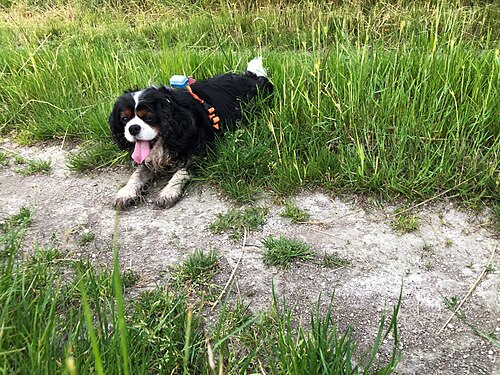
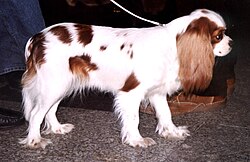

Cavalier King Charles Spaniel
🧠 Temperament & character
The Cavalier is a decidedly friendly, cuddly dog who seeks closeness and likes best to be with his people at all times. He gets on splendidly with children, other dogs and pets and shows little guarding or prey drive. Adaptable and balanced, he fits into almost any daily routine, as long as he is offered company. His gentle, good-natured character makes him one of the most easy-going companion dogs there is.
📜 Origin & history
Small spaniels of this kind were already popular in the England of the Tudor and Stuart eras and owe their name to King Charles II, who passionately loved the dogs. Over time the muzzle became ever shorter through crossbreeding, until in the 1920s the longer-nosed, original type was deliberately bred again – today's Cavalier King Charles Spaniel. He emerged as a counterpart to the short-headed King Charles Spaniel and was recognised as a breed of its own in 1945. Today he is one of the most popular companion dogs in Europe.
✂️ Grooming, care & training
The silky, medium-length coat with the feathered ears and legs needs regular brushing, especially behind the ears, where it mats easily. The Cavalier has a moderate need for exercise: daily walks and play are enough, though he can also be won over for longer hikes. He is teachable, sensitive and easy to train with a gentle, positive method. Because he is very people-oriented, being left alone should be trained carefully.
🩺 Health
Unfortunately the Cavalier King Charles Spaniel is heavily affected by two hereditary diseases: mitral valve disease of the heart, which many animals develop in middle age, and syringomyelia, a painful disease of the spinal cord. Life expectancy is about 9 to 14 years and depends greatly on the quality of the breeding. It is essential to insist on heart-tested (and ideally MRI-screened) parent animals whose cardiac findings and age are documented. Buying from a health-conscious, reputable breeder is especially important with this breed.
🏡 Who is this breed right for?
The Cavalier King Charles Spaniel is a near-ideal family and companion dog – suitable for families with children, couples, seniors and first-time owners alike. He fits both an apartment and a house and above all needs plenty of human company. For people who are often out and about and would frequently have to leave their dog alone, he is less suitable. In Switzerland he is a popular, uncomplicated companion for town and country – the only crucial thing is the careful selection of a health-oriented breeder.