Hiking with your dog in Switzerland: the loveliest routes & the most important rules
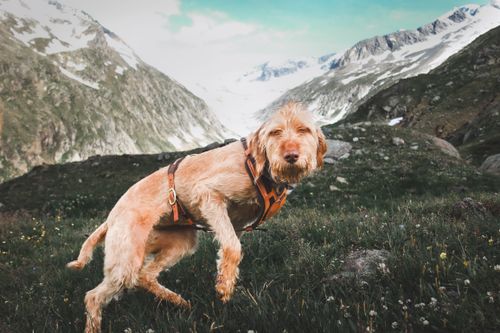
There are few countries where you can hike with a dog as easily as in Switzerland. Within an hour you're standing at a turquoise-blue mountain lake, in the next valley a shady gorge awaits, and most of the paths are well marked and easy for the dog to walk. Add to that mountain railways that take four-legged guests along, and a hiking culture in which dogs simply belong.
So that the outing stays lovely for everyone, a bit of preparation pays off. Where does it work especially well with a dog? And what do you need to watch out for with cows, wildlife and heat? Here come the loveliest destinations and the rules you really should know.
Mountain lakes worth it with a dog
A cool mountain lake is worth gold at the end of a hike — for you to catch your breath, for the dog to drink and cool off. The classic is the Oeschinensee near Kandersteg, deep blue and framed by steep rock walls. Anyone who prefers something gentler drives to Flims to the Caumasee with its wooded shore. Above Grindelwald lies the Bachalpsee, which on clear days mirrors the Bernese peaks.
In the Graubünden region the Lai da Palpuogna near Bergün is a little jewel, especially in autumn when the larches turn golden. In eastern Switzerland the path to the Seealpsee leads right into the Appenzell Alpstein range, and in the Glarus region the Obersee can be combined with the larger Klöntalersee into a quiet loop. Take water for the dog along anyway: not every lake is easily accessible, and standing or very cold water isn't always ideal.
Gorges, forests and waterfalls
On hot days, shady, damp paths are often more pleasant than the blazing high-altitude sun. The Aare Gorge near Meiringen leads along walkways right beside the roaring water — impressive, but keep the dog well on a short lead here. Similarly spectacular is the Rhine Gorge, the Ruinaulta, near Versam, often called the Swiss Grand Canyon. A little further east, the Viamala near Thusis shows how deep a river can carve into the rock.
In French-speaking Switzerland, the Creux du Van near Neuchâtel is a natural rock amphitheatre with a wide view — a magnificent destination where you have to be especially careful because of the drop-offs and the animals often grazing there. In Tessin the Verzasca valley near Lavertezzo lures with its emerald-green water, in Wallis the ancient Aletsch forest above Riederalp and Bettmeralp with a view of the great glacier. And the Rhine Falls near Neuhausen are a worthwhile stop with a dog too — as long as he takes the hustle and bustle calmly.
Whole regions for a hiking holiday
Anyone staying longer will find good terrain in every corner of the country. The Bernese Oberland combines mountain lakes, high trails and railways in a small space. Graubünden is huge and quiet — from the Engadin via Flims-Laax to Arosa and Davos there are countless routes. Tessin scores with the Verzasca, Maggia and Centovalli valleys, where a southern climate and wild water beckon; here you're better off starting early, it gets hot.
In Wallis the range reaches from the Aletsch area to the Zermatt region. Central Switzerland brings the classic viewpoint mountains with Rigi, Pilatus and Engelberg, many of them comfortably reachable by railway. And anyone who likes it gentler and cooler is well served in the Jura and the rest of French-speaking Switzerland with wide, wooded heights. For the concrete choice, the map on the website helps you further.
Relaxed to the top with mountain railways
A big advantage in Switzerland: many mountain railways and cable cars take dogs along, usually for a dog ticket or a reduced fare. That's more than convenience. You gain altitude without straining your dog's paws on long, hard climbs, and you can avoid the exhausting descent when the dog is tired.
In practice that means: plan the rides in advance, keep the dog calm and on the lead in the gondola or on the train, and when it's busy be considerate of the other guests. A quick reach for the lead when getting on and off prevents a rush. On hot days especially, going up by railway and down on foot is often the most dog-friendly option.
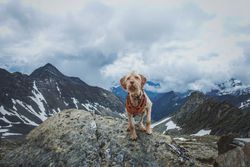
Cows, nursing cows and grazing livestock — the most important rule
On Swiss alpine pastures you'll almost always come across livestock, and this is exactly where most incidents happen. The basic rule: keep a large distance from cows, most especially from nursing cows with calves. They defend their young and quickly see a predator in the dog. Lead your dog on a short lead and under close control past a herd — or better make a big detour.
Never walk with the dog right through a herd. And now the point that can save lives: if a cow does actually attack and comes at you, let the dog off the lead so it can flee — and doesn't drag you along. A leashed dog pulling in panic puts you in danger. Free, the dog can get itself to safety, and the cow loses interest in you. Stay calm, leave the pasture briskly, don't turn your back on the cow and don't run.
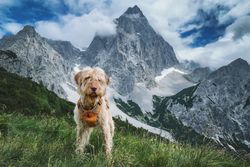
Wildlife rest zones and the leash requirement in the forest
Wildlife needs retreats, especially in winter and in the breeding and calving season. Respect signposted wildlife rest zones and stay on the permitted paths there. In many cantons and municipalities a leash requirement in the forest also applies in spring, typically from around April to the end of July, when fawns and ground-nesting birds are especially vulnerable. The exact dates differ by canton and municipality.
Don't rely on your gut feeling, but on the signs on site — they tell you what applies right now. A dog that can be reliably recalled is worth gold in the terrain, but in the calving season even the best-behaved hunter belongs on the lead. It's not about spoiling the dog's fun, but about new life getting through at all in spring.
Heat, paws, ticks and enough water
Dogs regulate heat worse than we do. On hot days you therefore start early, take breaks in the shade and, in case of doubt, turn back. Hot rock and long scree fields take their toll on the paws — check the pads regularly, and for sensitive dogs booties can make sense. Always take enough water and a bowl along; don't count on there being a stream flowing along the way.
Ticks are an issue throughout Switzerland: search the dog thoroughly after the tour and remove ticks with a tick tool. In rocky, sunny spots in the south, adders can also occur — keep the dog on the path there and away from piles of stones and tall grass. If the dog shows weakness, pants extremely or staggers, shade, water and rest are called for immediately.
The right route and the packing list
The loveliest route is no use if it overwhelms the dog. Adjust distance, elevation gain and difficulty to your dog's age and fitness. Puppies and senior dogs need shorter, gentler loops; a young, well-trained dog manages considerably more. Exposed sections with ladders or via-ferrata-like spots are not suitable for dogs — in that case look for another option.
And please: in the mountains too, take poop bags along and carry the droppings back out with you. The alpine pasture is feed for the cows. For the rucksack, this list has proved its worth:
- water and a foldable bowl
- snacks for along the way
- a tick tool
- a small first-aid kit
- a towel for wet or dirty dogs
- enough poop bags
Before setting off, take a look at the weather report and have a plan B ready in case it gets too hot or too uncomfortable.
You'll find even more dog-friendly routes and destinations on our Hiking with your dog page and in the overview of all places on the map. And if your dog most likes to jump into the water after the hike, take a look at our article on swimming with your dog.