Pug: Temperament, Care and Health in an Honest Portrait

The Pug is a charmer with a wrinkled face, plenty of humour and a big heart for its people. It is considered affectionate, sociable and very family-friendly. But as lovable as it is, so important is, in this flat-faced breed, the honest look at health, because its typical appearance brings serious risks.
This portrait shows where the Pug comes from, what defines it, who it suits and what you absolutely should know about breathing, heat, eyes and health. The compact breed data is also in the Rassen-Wiki entry on the Pug.
Origin and history
The Pug is a very old breed, originally from China, where small, flat-faced dogs were kept centuries ago at the imperial courts. Via trade routes it came to Europe and became the popular companion dog of the nobility there.
From the start the Pug was a pure society and lapdog, bred for closeness to people. This history explains its friendly, affectionate nature. Unfortunately, the muzzle was bred ever shorter over time, which has contributed to today's health problems. The original Pug had a noticeably longer muzzle, and that is exactly where responsible breeders are working to return.
Appearance: size, weight and coat
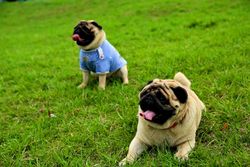
The Pug is a small, compact and squarely built dog with a shoulder height of about 25 to 30 centimetres and a weight of around 6 to 8 kilograms. Characteristic are the round, wrinkled face, the large eyes and the curled tail.
The coat is short, smooth and fine, mostly fawn with a dark mask or black. Despite the short coat, the Pug sheds surprisingly heavily. The facial folds, which must be kept clean and dry or inflammation threatens, need special attention, see the guide to coat care.
Temperament and character
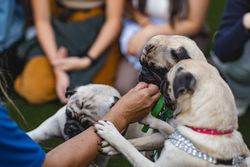
The Pug is friendly, cuddly, sociable and endowed with lots of humour. It loves its family above all, likes to be in the middle of everything and usually gets on very well with children and other animals. As a guard dog it is of little use, but it is a wonderful social partner that loves company above all and most likes to be part of everything.
It is mostly calm and not keen on walking, but can have a stubborn streak. It tolerates being alone poorly. With friendly, consistent training and good socialisation, the Pug becomes an agreeable, relaxed companion.

Who is the Pug right for?
The Pug suits people who want an affectionate, apartment-suitable companion dog and can spend a lot of time with it. It suits city flats, seniors and families, as its exercise needs are low. Important are closeness, consideration for health and company.
It suits less well very sporty people looking for an endurance partner, or anyone who cannot be considerate of heat in summer. Anyone who does not want to bear possible vet costs either should think the decision over.
Breathing, heat and the flat-face issue
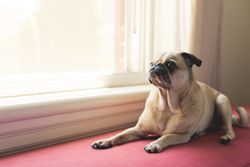
Like the French Bulldog, the Pug is brachycephalic, that is, flat-faced, and many suffer from the brachycephalic syndrome, which impairs breathing. Loud snoring, rattling and quick exhaustion are not cute peculiarities, but warning signs to be taken seriously.
Especially dangerous is heat: flat-faced dogs regulate their body temperature poorly and are highly prone to heatstroke. Strictly avoid exertion and heat in summer, heatstroke is an emergency, see the guide to first aid. Comparable topics are covered in the French Bulldog portrait.

Further health matters
Besides breathing, the Pug's large, protruding eyes are prone to injuries and inflammation. Skin inflammation in the folds, back and vertebral problems as well as a strong tendency to overweight are also common. Overweight worsens breathing further, see overweight.
All the more important is the choice of a responsible breeder that deliberately selects for freer airways, a somewhat longer muzzle and health and has the parent animals examined. For any abnormalities, the vet is the right place.
Getting one in Switzerland
With the Pug too: the origin decides health and quality of life. Avoid cheap offers and dubious imports, which are often sick and without certificates. Choose a breeding operation that puts health before the extreme looks and speaks openly about the breed's problems.
More and more breeders are striving for healthier, somewhat longer-nosed Pugs, which is a step in the right direction. Registration in the dog database is mandatory, see the guide on AMICUS. Given the possible costs, dog insurance is worthwhile, and the puppy starter kit shows what is needed at the start.
Conclusion: is the Pug right for you?
The Pug is a lovable, humorous and affectionate companion dog that fits wonderfully into close family life and also copes well in the city. Anyone who spends a lot of time with it and is considerate about heat and health finds a loyal friend.
The decision for this breed should, however, be a conscious one, with eyes open to the health risks of the flat face and a clear choice for a responsible, health-focused origin. Only that way does one truly do the Pug justice.
Frequently asked questions
Why does my Pug snore so loudly? Loud snoring and rattling can be signs of the brachycephalic syndrome. Have the breathing assessed by the vet, it is not a harmless trait.
Does the Pug cope with summer heat? Only poorly. As a flat-faced dog it is highly prone to heatstroke. Avoid heat and exertion and go out at cool times of day.
How much exercise does a Pug need? Only moderate. Short, calm walks and some play suffice. Do not overdo it, especially in warmth, and watch the breathing.
Does the Pug tend to overweight? Yes, strongly. It is greedy and gains weight quickly, which burdens breathing and joints. Fixed portions and weight control are important.
Note: this guide offers general orientation and does not replace a veterinary examination or advice. If your dog has a health problem or in an emergency, please consult your vet.