Trimming Your Dog's Nails: How to Do It Right
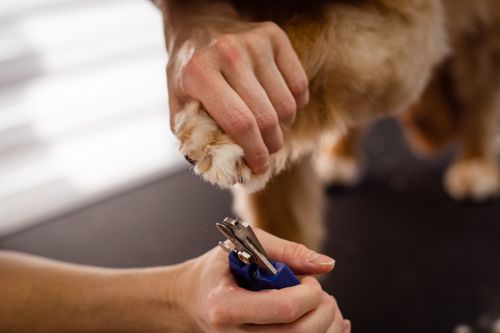
Click, clack, click – anyone who hears their dog walking across parquet or tiles and picks up a distinct clicking has already received the first clue: the nails are too long. Nail care is one of those tasks that many owners shy away from a little – out of worry about hurting the dog, or out of uncertainty about how far one may actually cut. This caution is understandable and even sensible, because you really can do something wrong when trimming nails. The good news up front: with a little knowledge of how the nail is built, the right tool and a steady hand, it is a task you can readily take on yourself at home.
In this guide we go calmly step by step through why nails that are too long harm the dog, how the nail is structured, how often it needs trimming and exactly how you go about it – including with dark nails, where you cannot see the inside. And we talk openly about when it is better to leave nail trimming to a professional.
Why Overly Long Nails Are a Problem
Nails keep growing throughout life, much like our fingernails. When they are too long, they are far more than a cosmetic flaw. As soon as the dog stands, overly long nails press up against the ground from below and push back into the toe. This changes the position of the toes, twists them over time and impairs the dog's whole posture and gait. What looks harmless can thus lead to uneven strain on the joints and to an unsteady, tense way of moving.
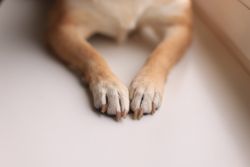
There is also the danger that overly long nails splinter or tear – this is painful and can bleed. In extreme cases they even keep growing in a curve until they bore into the pad. It should never get that far. A simple rule of thumb: if you hear clicking on hard floors, or the nails touch the ground when the dog stands still, then they are too long and it is time for a trim.
A Look Inside the Nail: Where the 'Quick' Sits
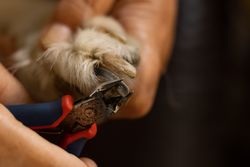
To trim safely, you have to understand how a nail is built. Inside every nail sits the so-called quick – a fine strand with a blood vessel and a nerve. This is exactly where the crux lies: if you cut into this quick, it hurts the dog and it bleeds. So what gets injured is never the hard outside but the sensitive inside.
That is why the golden rule applies: you only ever shorten the horny tip in front of the quick, never the quick itself. With light, translucent nails you have it easy – there the quick shimmers through the horn as a pinkish core. You place the tool a few millimetres in front of this pink core and cut off only the tip. With dark nails the quick cannot be seen; we will look more closely at how to proceed in that case shortly. By the way: the quick grows along with the nail. If you trim regularly, it gradually recedes, and over time the nails can be kept shorter again.
How Often Do the Nails Need Trimming?
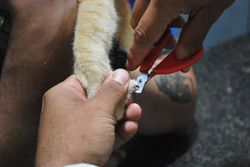
How often trimming is needed varies from dog to dog. Dogs that spend a lot of time on hard surfaces such as asphalt often wear their nails down all by themselves and rarely need the clippers. Others – especially dogs that mostly walk on soft ground such as meadows and forest paths – get little of this natural wear and have to be trimmed roughly every few weeks. What matters, then, is not the calendar but the regular check: better to inspect the nails often than to trim rigidly by schedule.
You should keep a particular eye on the dewclaw – that additional nail which sits a little higher up on the inside of the leg. Because it does not touch the ground, it never wears down. If it goes unnoticed, it keeps growing in a curve and can bore into the skin. So check it too at every inspection. One more word on older dogs: they usually move less and therefore wear their nails down less well – here it is worth looking more often.

Step by Step: Tools and Technique
For trimming nails you need the right tool. A nail clipper has proven itself – it comes in a scissor and a guillotine design – or an electric nail grinder, which removes the nail in tiny amounts. Some dogs tolerate the grinder better, because it works more gently and in small steps. What matters in every case is that the tool is sharp and made for dogs.
Now the technique: make sure there is good light, so that with light nails you can spot the pink core. Take the paw calmly into your hand without pulling and press it gently so that the individual nail stands out well. Then cut off the horny tip – and rather take a small piece off several nails than too much off a single one. That way you feel your way forward safely, without hitting the quick. Work calmly, take breaks and force nothing. A cut that turns out a touch too short is better than a hasty one that goes too deep.
With dark nails particular caution is called for, because here you cannot see the quick. The solution: take off only very thin slices and look at the cut surface after each cut. If a small, light or greyish circle appears in the middle of it, you are already close to the quick – now you stop. This light spot is your warning signal; going any further would be risky. Better to trim off another little piece a few days later than to risk too much at once.
If You Do Cut Too Far
Even with all due care it can happen that you hit the quick – this occasionally happens even to practised hands. The nail then bleeds and stings briefly. The most important thing now: stay calm, because otherwise your tension carries over to the dog. Press a clean cloth firmly onto the nail or apply some styptic powder, which stops the bleeding. Afterwards keep the dog quiet until everything has scabbed over – so do not let it romp around straight away.
In the vast majority of cases such a small bleed is harmless and soon stops on its own. You will find the basics for such moments in our article on first aid for dogs. But if the bleeding does not come to a stop, do not hesitate and turn to your vet.

Getting Your Dog Used to It Patiently
Much becomes easier if the dog is familiar with having its paws touched from an early age. It is therefore best to start as early as puppyhood to take the paws in your hand regularly – combined with praise and a treat, so that the dog associates the touch with something pleasant. How to gently accustom your young dog to such handling, you can read in our puppy checklist.
Then build up the actual trimming in tiny steps: first just a single nail, then lots of praise, and stop – it is best to always finish on a good note, before the dog becomes restless. That way the whole thing stays positively associated. What you should absolutely avoid is holding the dog down, wrestling with it or even punishing it. Fear only makes everything harder next time – patience, on the other hand, pays off in the long run.
When It Is Better to Leave It to the Professionals
Not every dog and not every nail can be trimmed at home without trouble. In these cases you are in better hands with a professional:
- if your dog is very anxious and simply will not let itself be touched;
- if the nails are dark and you are unsure how far you may go;
- if the nails have been neglected for a long time and the quick has grown out with them – then the nail has to be shortened gradually over several weeks so that the quick can recede.
A dog groomer or the vet practice will gladly take on the nail trimming – or calmly show you how it is done the first time, so that you can do it yourself later. Letting someone help you is no sign of clumsiness but of responsibility: better to have the nails trimmed expertly once than to hurt the dog out of uncertainty. That way nail trimming stays a relaxed matter for you both.
Note: this guide offers general orientation and does not replace a veterinary examination or advice. If your dog has a health problem or in an emergency, please consult your vet.