Getting Dog and Cat Used to Each Other: How Living Together Works
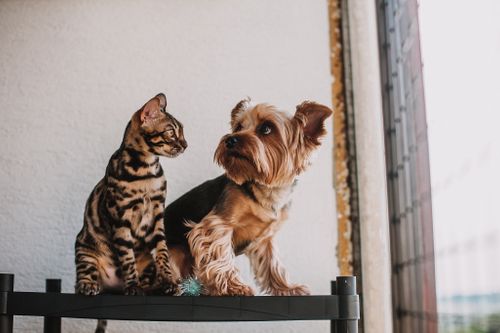
"Like cat and dog" is what we say about two who can't stand each other. As a fixed rule, though, the picture doesn't hold. With a slow, well-managed introduction and a little respect for both characters, the vast majority of dogs and cats learn to live under one roof. Some even become really close friends, dozing together on the sofa and greeting each other at the kitchen door in the morning.
The key almost always lies in the beginning. Anyone who simply puts the two together and hopes they'll sort it out between themselves risks a false start that's only tedious to correct afterwards. Whoever, on the other hand, takes their time, proceeds in small steps and stays at the cat's pace, lays the foundation for an easy-going coexistence. Important upfront: it always goes with reward and calm, never with force or punishment.
And have realistic expectations: whether the two become best friends or two flatmates who politely keep out of each other's way is, either way, a success. The main thing is that neither is under permanent stress.
Before they see each other for the first time
The biggest mistake is a meeting in the hallway on day one. First set up a room of its own for the newcomer, where it can arrive entirely by itself. There you have food, water, a cosy sleeping place and, for the cat, the litter box. That way the new animal gets used to the unfamiliar smells, sounds and layout in peace, without immediately facing the other.
In these first days you work with the nose, not the eyes. Swap blankets or baskets and put a blanket the dog has used in the cat's room and vice versa. That way each links the other's scent with familiar everyday life, long before they see one another.
A proven intermediate step is sniffing under the closed door: dog and cat notice each other but can't get at one another. If both stay calm, reward it with a treat or a friendly word, on both sides of the door. That way the first meeting later is no longer a complete surprise.

The first meeting: short and controlled
When both seem relaxed, the time comes for the first face-to-face meeting. Deliberately keep it short and calm. The dog is on a loose lead and stays as composed as possible. A tired dog is the better candidate, so take a proper walk beforehand. The cat you leave free: it has to be able to decide for itself whether to come closer or keep its distance. This very freedom of choice takes the pressure off it.
Never force contact. Nobody is carried over to the other, nobody is held so that the other can sniff them. Instead, reward calm behaviour: if the dog looks away calmly rather than fixating on the cat, there's praise and a treat. If the cat stays sitting loosely rather than hissing, the same.
End the meeting while it's still going well, better a minute too early than one too late. A positive ending stays in both their memories. Then you repeat the whole thing, day by day, and slowly stretch out the shared moments. Seconds turn into minutes, minutes eventually into a relaxed being side by side in the same room.

The cat needs escape routes and retreats
A cat only feels safe if it can get out of the way at any time, ideally upwards. Make sure this way is always open to it. In concrete terms that means, for example:
- a sturdy scratching post or high shelves to jump up onto
- a baby gate that only the slim cat can pass, but not the heavy dog
- at least one room that stays completely closed to the dog
- clear escape routes that the dog can't block with its body
These retreats are not a luxury but the basis of everything. A cat that knows it can bring itself to safety at any time stays far more relaxed, and a relaxed cat provokes the dog less. The only important thing is that the zones really do stay dog-free and reliable, otherwise the cat loses its trust in them.

Separate bowls, separate litter box
Tension arises quickly around food, so feed dog and cat separately. The simplest way is to put the cat up high, on a windowsill, a shelf or behind the baby gate, where it eats in peace and the dog can't get at its bowl. That way there's no food envy and no scuffle when one finishes faster than the other.
The cat's water and above all the litter box also belong out of the dog's reach. Dogs raiding the litter box is a classic: a snack for the dog, a real nuisance for you, and for the cat a reason to avoid the box altogether. You prevent both by putting the box somewhere only the cat can reach: behind a gate, in a room with a cat flap, or up high. Such separate resources take a lot of conflict potential out of everyday life, because everyone has their safe place to eat, drink and do their business.

Never leave them alone unsupervised
However well it's going: don't leave dog and cat alone together as long as you don't yet fully and completely trust the relationship. In the early days it holds true: always be there, always keep an eye on things. What looks harmonious in your presence can tip over without you, and a single bad incident throws you a long way back.
When you leave the house, you separate the two: the dog in its area, the cat in its own, a closed door or a sturdy gate is enough. That's not a vote of no confidence but the safe option, until you have experienced over weeks that both stay relaxed even in quiet moments. You choose the first unsupervised moment deliberately and late: better a few weeks too cautious than once too early.

Reading body language correctly
Both animals are constantly telling you how they feel, you just have to look. A dog that goes stiff, stares at the cat and can no longer be spoken to is too worked up: here the thing to do is immediately take the pace out and create distance. A cat that hisses, arches its back, ducks flat or is cornered is saying quite clearly: too much, too fast. A few warning signals at which you take a step back:
- the dog fixates rigidly on the cat, whines or pulls tensely on the lead
- the cat hisses, growls, puffs up its tail or flattens its ears
- one of the animals freezes completely or flees in a panic
- the cat suddenly avoids rooms, its litter box or its feeding place
Very important: hissing and growling are not cheek but communication. They say "this is too much for me". Never punish that. Whoever switches off the warning signal may get no warning at all next time. Take the signal seriously, go a step back and make it calmer next time. Relaxed signs such as a loose body posture, normal eating, sleeping in the same room or curious rather than rigid sniffing show you, conversely, that you're on the right track.
Puppy, kitten or a dog with a strong hunting drive?
How easily the introduction works depends heavily on the two individuals. Puppies and kittens usually have it easiest: they're still malleable, curious and carry no bad experiences with them. If they grow up together, the matter often takes care of itself.
It gets more demanding with an adult dog with a strong hunting or chasing drive. For him a cat running away can reflexively become a prey stimulus, which has nothing to do with malice but with instinct. Here you need more caution, more management and usually more time: consistently on the lead, lots of reward for calm behaviour, and no situation in which the dog could chase after the cat. Not every combination is solvable in every case, but very many are, with patience.
If you're unsure or it's stuck, get support early. A good dog school or a behaviour specialist sees things you overlook yourself, and saves you detours. That's not a sign of failure but of responsibility.
Patience, and the happy ending
In the end patience is the most important ingredient. Depending on the two animals, getting used to each other takes a few days, a few weeks, sometimes longer. Don't let it discourage you. Every calm shared moment, every relaxed being side by side is a step in the right direction.
Always go at the cat's pace, work with reward instead of pressure, and take joy in the small steps. And then it comes, that day when the dog stays lying down with a yawn while the cat struts through the room, and neither makes a drama of it any more. That's exactly what you're working towards.
Still at the beginning with the dog? In our puppy guide you'll find everything for the start, and anyone still planning the acquisition is best off reading beforehand which breed suits whom, hunting drive included. And if you'd like personal support for the introduction, our overview of dog schools and specialists will help you find the right assistance near you.