How Much Food Does My Dog Need? Getting Portions Right
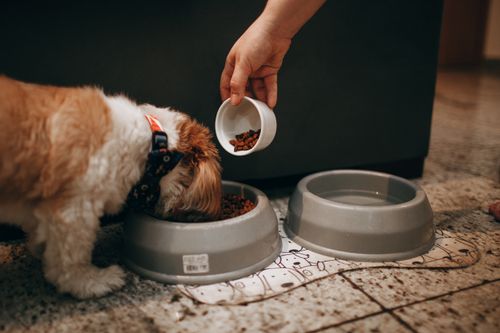
The question of the right amount of food is one of the most common – and most important. Overweight is widespread among dogs in Switzerland and encourages joint problems, diabetes and a shorter life. At the same time the dog should of course be full and supplied with all nutrients.
The good news: with a few simple basics you quickly find the right amount without constant guessing. The key is to treat the figures as a starting point and then adjust on your own dog – two dogs of the same weight can need very different amounts.
Where you start: the package guideline
Every finished food carries a feeding table by body weight. It is the best first reference because it matches the energy density of that food. Find the row for your dog’s target weight – not its current weight if it should gain or lose.
Note: these tables are calculated rather generously. Many dogs need slightly less, especially if neutered or not very active. Take the value as an upper limit and watch the effect over two to three weeks before adjusting.
The body check beats any table
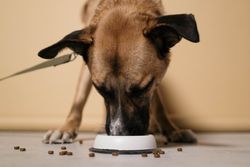
The most reliable method is the Body Condition Score. You should be able to feel your dog’s ribs with light pressure without seeing them. From above a clear waist is visible; from the side the belly tucks up toward the rear.
If the ribs are padded and the waist has vanished, the dog is too heavy. If the ribs stand out visibly, it is too thin. This assessment beats any gram count because it accounts for your dog’s individual metabolism. Make it a routine every two to three weeks.
Factor in activity, age and neutering
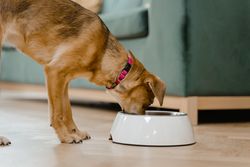
A young, sporty dog burns far more than a calm family dog. After neutering the energy requirement often drops by 20–30 % while appetite stays the same – so watch the amount closely here, or overweight creeps in.
The season plays a part too: in winter with more movement in snow the need can rise; on hot, low-activity summer days it falls. Older dogs usually need less energy but still high-quality protein. Adjust the amount to these phases.
Do not forget treats
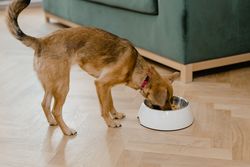
An often underestimated point: treats, chews and training rewards count toward the daily ration. As a rule of thumb they should make up no more than about 10 % of daily energy. If you train a lot, deduct this amount from the main food.
In practice, weigh out the daily ration in the morning and take treats from it. That way no hidden weight creeps in, and you keep the overview even if several people in the household feed.
How many meals a day?
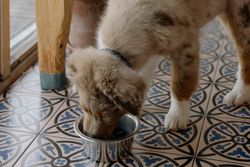
Adult dogs usually get their daily ration split into two meals – gentler than one large portion and more satisfying across the day. Puppies eat more often, usually three to four small meals. More on this in the Puppy guide.
Fixed times help digestion and daily life. In large, deep-chested breeds it is advised to keep things calm around feeding and avoid wild play right after eating.
Wet, dry or mixed – what it means for the amount
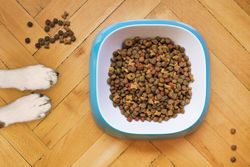
Dry food is highly concentrated: small amounts deliver a lot of energy because it contains almost no water. Wet food, by contrast, is largely moisture – so the dog needs a much larger amount in grams to reach the same energy. When switching from dry to wet, do not be fooled by the larger portion in the bowl.
With mixed feeding it easily gets confusing. The most reliable method is to calculate each part by its own table and then combine them proportionally – for example half the dry ration in the morning, half the wet ration in the evening. This stops the energy adding up unnoticed and the dog slowly gaining weight.
On top of that: fresh water must always be available, especially on pure dry feeding. A dog that eats a lot of dry food drinks more – that is normal and important for kidneys and digestion.
Frequently asked questions
My dog always seems hungry – is it getting too little? Not necessarily. Many dogs beg out of habit or boredom, not real hunger. What counts is the body check: if shape and weight are right, the amount is right, even if the dog would like more.
Should I reduce the amount in summer? If your dog is clearly less active in the heat, the need drops slightly – adjust the amount to actual activity, not the calendar.
How quickly do I see whether the amount is right? Weight changes show over weeks, not days. Weigh your dog every two to four weeks and correct in small steps.
When several people feed the dog
An often overlooked cause of creeping overweight is feeding by several people. When partner, children and grandparents each slip in “just a little piece”, it adds up over the day to a second meal – without anyone noticing. The dog quickly learns with whom begging pays off.
The simplest solution is coordination and transparency. Weigh out the daily ration in the morning and place it in a labelled container – everything the dog gets that day comes from this amount, treats included. That way everyone sees at a glance what has already been fed.
In families especially it is worth agreeing on clear rules: who feeds when, what is allowed and what is not. This protects the dog’s figure, prevents begging at the table and ensures a relaxed, predictable daily life for everyone.
When to look more closely
If your dog steadily gains or loses weight despite a suitable amount, if its eating behaviour suddenly changes or it seems constantly hungry, it is worth looking beyond the amount alone. Metabolic or hormonal disorders can lie behind it.
In such cases the veterinary practice is the right address. It can assess the weight objectively, create a feeding plan and investigate causes. In healthy dogs a regular body check is usually enough.