Muzzles for dogs: habituation, choosing one and the rules in Switzerland
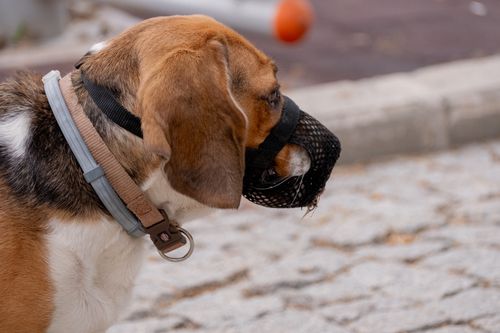
For many people, a muzzle first suggests a dangerous dog – an animal you cannot trust. That image is stubborn, and it is wrong. A muzzle is not the mark of a biting or badly raised dog, but a perfectly normal safety tool that responsible owners use deliberately. It protects the dog, the people around it and others – and in many situations it is simply the most sensible thing to do.
In this guide we look calmly at when a muzzle is genuinely useful, what the legal situation in Switzerland is, which type of muzzle is the right one – and above all how to get your dog used to it step by step and without force. Because a muzzle that the dog wears willingly and relaxed is, in the end, the best solution for everyone.
When a muzzle makes sense
A muzzle is not something you put on the dog forever – but there are situations where it is very useful or even necessary. The most important case is the medical emergency. An injured or frightened dog can bite, even the gentlest and most loving one – this is not ill will but a reflex born of pain and panic. Anyone who has ever had to help a dog with a painful injury knows how quickly it can happen. In such moments a muzzle protects you, the person helping and, ultimately, the dog itself. You can read how to react correctly in an emergency in our article on first aid for dogs.
At a visit to the vet too, a muzzle can make the appointment calmer for everyone – especially when a treatment might hurt. Many practices appreciate it when a dog already knows the muzzle and does not meet it for the first time in an already stressful waiting room. Other typical situations are:
- crowded situations on public transport, for example on a full tram or train, where your dog cannot keep its distance;
- situations in which a muzzle is expressly required – more on that shortly;
- as protection for dogs that eat everything off the ground: a basket muzzle can help prevent the swallowing of poison bait.
The mindset behind all this matters: in every one of these cases the muzzle is protection – for the dog and for those around it – and not a punishment, nor an admission that something is wrong with the dog.
Is there a muzzle requirement in Switzerland?
Here is the most important message right away: there is no general muzzle requirement for all dogs in Switzerland. No dog has to wear a muzzle just like that, in ordinary everyday life. Whether a muzzle is required depends on the specific situation and on where you live.
On public transport – so on the train, tram and bus – the leash is the standard, not the muzzle. Dogs must be kept on a lead and must not endanger the other passengers. There is no general muzzle requirement on public transport; the transport companies may, however, require a muzzle in individual cases. To be on the safe side, it is best to check the current conditions of the transport company in question. Our article on travelling with your dog explains in detail how it works.
It is different for cantonal and municipal rules. The cantons regulate a great deal around the dog – and some require a muzzle in public for certain dogs. This concerns above all so-called listed dogs, that is, breeds or types that appear on a cantonal breed list. In individual cantons a leash and/or muzzle requirement can apply to such dogs. Because these rules vary strongly from canton to canton and keep changing, the rule is: never rely on hearsay, but check the official, current rules of your canton. Our rules by canton give an overview, and our article on listed dogs explains how the topic of breed lists works.
One more word on the ticket, because the question often comes up together with the muzzle: small dogs in a carrier bag usually travel free, while larger dogs need a ticket – for example a dog day pass or a half-fare 2nd-class ticket. The exact conditions vary by transport company, so it is best to check the current conditions.
Which muzzle is the right one?
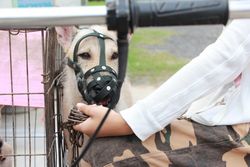
Just as important as the training is the choice of the right model – and here there is a clear favourite. For anything that lasts longer than a brief moment, the basket muzzle is the right choice. It encloses the snout like a little basket and is made of plastic, metal or Biothane. Its great advantage: the dog can open its mouth in it, so it can pant, drink and even take treats. Panting in particular is crucial, because it is how a dog regulates its body temperature.
To be distinguished from these are the soft sleeve muzzles made of fabric or nylon, which hold the mouth shut. They look practical but have one serious drawback: the dog cannot open its mouth in them and therefore cannot pant. That carries a real risk of overheating. Such models are suitable at most for very short procedures, for example a brief moment at the vet – never in the heat and never for longer wear.
As for the fit: the muzzle should sit well without cutting in or pressing. It must not chafe or slip, but the dog must be able to open its mouth wide enough to pant comfortably. Better to check the size once too often and adjust it calmly than to use a poorly fitting model.

Muzzle training, step by step
A dog is not born with a muzzle, and no one likes having something pulled over their nose. That is why the most important thing in muzzle training is patience: it happens in many small, positive steps – and never with force. The goal is for the dog to associate the muzzle with something pleasant and to slip its nose in of its own accord. Here is how you can go about it:
- Step 1: show the dog the muzzle and reward it just for noticing or sniffing at it. The mere sight of it should mean something good.
- Step 2: put treats through or inside the muzzle, so that the dog puts its own nose in to fetch them. That way it takes the first step voluntarily.
- Step 3: hold the muzzle briefly against the snout while the dog has its nose in it, and reward immediately.
- Step 4: close the strap for a few seconds and reward right afterwards – then take it off again while the dog is still relaxed.
- Step 5: slowly increase the wearing time over many short sessions, always positively and always so that the dog has good experiences.
Do not overdo the pace. Better many short, relaxed exercises than one long one in which the dog becomes restless. If you always stop before it has had enough, the exercise stays positively associated. The same patient principle applies to almost everything in dog training: working in small steps and with rewards gets you further than pressure.
What you must absolutely avoid
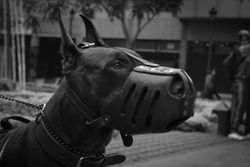
A few mistakes quickly turn this useful safety tool into something harmful. Fix them firmly in your mind:
- Never use the muzzle as punishment. It must never be linked to anything negative, or the dog will eventually refuse it altogether.
- A muzzle is not a means against barking or chewing. It is not intended for that and does not solve the underlying problem.
- Never use a soft fabric or nylon sleeve in the heat or for longer wear – the risk of overheating is real.
- Do not rush the training and do not force the dog into anything. Fear only makes everything harder.
If you are unsure which muzzle is suitable or how best to build up the training, get support – for example at a good dog school or from your vet.
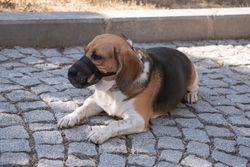
The muzzle as part of a relaxed everyday life
Let us hold on to this: a muzzle is not a verdict on your dog, but a tool that, at the right moments, brings safety and calm – at the vet, on a crowded train, in an emergency or as protection against poison bait. There is no general requirement in Switzerland, but depending on the canton, the situation and the transport company, rules can apply – so always check them for your specific case. And when your dog wears the muzzle willingly and calmly thanks to patient training, it is not a sign of danger but of responsible ownership. That is how an unloved object becomes a natural part of your shared everyday life.