Prey Drive in Dogs: Understanding, Managing and Training
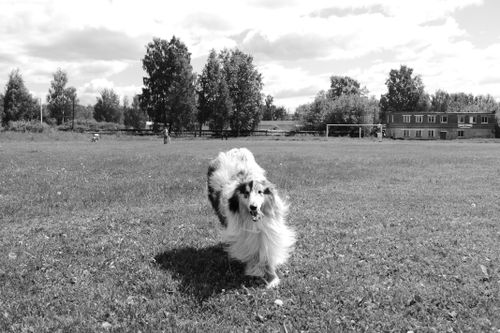
It is one of the most common worries of dog owners: the dog spots a deer, a hare or a cat, and it is already unreachable, racing off. Such moments are dangerous, because the dog can run into a road, injure itself or kill wildlife, and they are deeply frustrating for many owners.
Prey drive is deeply anchored in the dog and cannot simply be trained away. What is possible: to understand it, manage it safely and, through targeted training, channel it enough that relaxed walks become possible again. This guide shows how.
Why dogs chase
Chasing is a natural, self-rewarding behaviour for dogs. Even the chase releases feel-good hormones, so the dog does not even need to make a kill to be satisfied. This explains why prey drive is so persistent: it carries its reward within itself and grows stronger with every repetition.
How strongly prey drive is expressed also depends on the breed. Many dogs were bred over generations for specific tasks, such as chasing, flushing or retrieving. A high prey drive is therefore not a vice, but often simply part of the nature of the particular dog.
Understanding the prey sequence
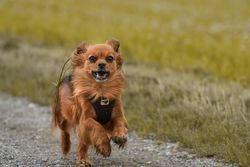
Hunting runs in a fixed sequence: locate, fixate, stalk, chase, grab and kill. This chain is called the prey sequence. In some breeds certain parts are especially pronounced, while others have been bred down. Anyone who recognises at which link their dog joins in can intervene earlier.
The key is to interrupt as early as possible in the sequence, so already at locating or fixating. Once the dog is in the chase, it is barely reachable. So watch for the early signs: attentive stopping, pricked ears, a fixed stare and a suddenly stiff body.
Is that normal?
Yes, prey drive is entirely normal and part of the dog. It is not a sign of a badly trained or vicious dog. The goal is therefore not to extinguish the drive, but to control it and offer the dog permitted outlets where it can live out its need.
A realistic expectation helps to avoid frustration. In some dogs a very reliable recall succeeds even from the stimulus, in others the long line stays permanently necessary at game trails. Both are fine, as long as the safety of dog and wildlife is guaranteed.
Management: safety first
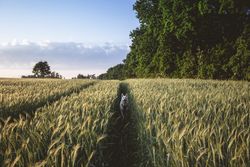
As long as the recall is not solid, a chasing dog belongs on a long line in a stimulus-rich environment. It prevents the chase and thus the self-rewarding experience that would otherwise further reinforce the behaviour. Safety always takes priority over training ambition.
Avoid situations at first where your dog could predictably chase successfully, such as walks at dusk along forest edges. Get to know the critical places and times and plan your walks accordingly. Every prevented chase is a training success.
Offering permitted outlets
A dog with prey drive needs a substitute offer, otherwise it finds its outlet itself. Controlled activities such as dummy work, tracking and nose work, a flirt pole or joint searching address the same needs, only in a permitted, guided form. That way the drive becomes a motor for cooperation.
Such occupation satisfies the dog and makes you interesting as an owner, because the good hunting experiences now happen with you. A satisfied dog that may live out its drive regularly in a controlled way is much easier to handle in everyday life.
Recall and stop signal
Two signals are central: a very well-built recall and a stop signal that the dog follows even when aroused. Both must first be consolidated in a low-stimulus environment and then practised slowly under increasing distraction. Reward generously, precisely when the dog turns away from the stimulus.
The build-up takes time and consistency, but pays off. Start small and only increase the difficulty when the previous stage is solid. The basics of building signals cleanly are in the guides to recall and dog training.
Anti-chase training in small steps
Effective anti-chase training starts early in the prey sequence and rewards the dog for orienting instead of bolting. A proven approach is to teach the dog to turn back to you on contact with wildlife, because that pays off more than the chase. This only succeeds with high-value rewards and patience.
Always work below the threshold at which your dog loses control, and with the safety of the long line. Do not overwhelm it with too much stimulus at once. Small, clean successes are worth more than risky jumps that end in failure and set the training back.
What does not help
Punishing after a chase is ineffective and harmful. The dog does not associate the punishment with bolting, but with coming back to you, and the recall gets even worse. Deliberately letting it run so the dog can let off steam also only reinforces the behaviour.
Miracle remedies or harsh tools that inflict pain or fear on the dog do not help either. They can worsen the problem and damage the relationship. The path runs through understanding, consistent management and positively built training, not through deterrence.
When to seek help
With very strong prey drive, repeated chasing or if you are not making progress in training, competent support is sensible. An experienced dog school or a trainer specialising in prey drive can adapt the training to your dog and guide you safely.
Also observe the legal side: in Switzerland a leash requirement applies in many places in forest and field, especially during the breeding season in spring. A dog that poaches can have legal consequences. Inform yourself about the rules in your region.
Frequently asked questions
Can prey drive be trained away completely? No, the drive remains. But you can control it, channel it and, with good training, take it far enough that safe, relaxed walks become possible.
When should I start anti-chase training? As early as possible, ideally already in the young dog. But with adult dogs too, clear progress is possible with patience and consistency.
Is a long line permanently necessary? That depends on the dog. In some it stays useful at game trails, in others it becomes superfluous with a reliable recall. Safety always comes first.
May my dog run free in the forest? This is governed by cantonal and municipal rules, often with a leash requirement especially in spring. Inform yourself locally to protect wildlife and yourself.