Dog and Baby: Preparing for the New Arrival
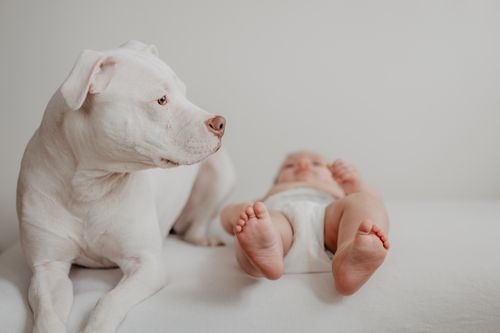
A baby turns life upside down – and that goes not only for the new parents but also for the dog, who until now was quite naturally the centre of the family. Suddenly the flat smells different, there is crying, rocking and carrying, and the attention that once belonged to the dog is directed at a tiny new being. The good news first: with calm, timely preparation, the vast majority of dogs handle this transition well – and over the years many become the growing child's most loyal companion. The magic word is time: those who start early and calmly take the fear out of the new arrival long before the baby is even here.
This guide walks you step by step through the most important stages – from starting early, refreshing training, gently adjusting daily life and setting up a retreat, to getting the dog used to baby noises and smells, the homecoming from the clinic and the first introduction. One rule runs through all of it like a thread and must never be broken – more on that below. And because every dog is an individual: if you are unsure or your dog is already showing problematic behaviour now, get expert support early rather than waiting.
Why you should start early
The most important principle is: start as early as possible, ideally months before the birth. A dog copes best with change when it comes gradually – and is not all associated with the baby at once. That is exactly the point of early preparation: if everything suddenly changes at the same time on the day of the homecoming – less attention, closed doors, unfamiliar smells, unusual noises – then the dog links all these upheavals with the new family member. If, on the other hand, you spread the same changes over weeks and months, most of the new routine is long familiar by the time the baby moves in. The calmer and the earlier you begin, the more smoothly the transition goes.
Refreshing the basics
A well-trained dog makes life with a baby many times easier. So it is worth calmly refreshing the most important basics now: settling relaxed on a blanket or on the cue "go to your place", not jumping up at people, walking on a loose lead, a reliable "leave it", and the ability to stay calm while your hands are full. The most valuable exercise is lying down calmly on cue and staying there – a dog that has this down reliably is an enormous help during breastfeeding, carrying and nappy changes. You will find a refresher on all the basic cues in our article on the basics of dog training.
If the cues are not yet reliable or you would like some guidance, now is the right moment to attend a good dog school – it is easier to learn as a pair, and an experienced trainer spots things you would miss yourself. You will find suitable options near you in our directory of dog schools. It is important that the training is friendly and without pressure: what a dog associates with pleasant feelings, it will also show reliably later when things get more hectic.
Adjusting daily life and creating a retreat
Think honestly now about what will change with the baby – and shift these things gradually weeks in advance, not just on the day of the homecoming. Will the walks move, the feeding times shift, or the amount of undivided attention shrink? Then gently get your dog used to it already now. That way it does not blame the baby for the change, but experiences it as something that is simply part of life right now. Feel free to build in small phases where you do not respond to every nudge – a dog that learns to be by itself and relax now and then copes far more easily later when your hands are full.
It is just as helpful to set up the flat early. Put up the cot, changing table and pram weeks beforehand, so that they become perfectly ordinary furniture rather than suddenly appearing, unsettling objects. Decide now which areas will be off-limits in future – the nursery, say, or the changing area – and practise these boundaries calmly and kindly, if need be with a door or a child gate. The most important thing of all, though, is a safe retreat: a bed or crate in a quiet spot that your dog can withdraw to at any time and where it is never disturbed – neither by visitors nor later by the toddler. A dog that has learned to relax and retreat on its own is much more balanced in family life; our article on relaxed time alone shows you how to build this independence.
Getting used to noises and smells
With a baby come new noises and smells that are unfamiliar to your dog. Both can be practised in advance. Play recordings of a crying baby – at first very quietly and always paired with something pleasant such as a treat, calm praise or feeding, so that the sound announces good things for the dog. Increase the volume only slowly over days and weeks, and always when your dog stays calm. Also let it sniff the new furniture and the creams, lotions and powders you will be using later – so these scents soon become familiar too.
In addition, practise calm walks with the empty pram, so that walking beside it becomes second nature before the baby is lying in it. And a particularly effective final step: before mother and child come home, bring a blanket or item of clothing carrying the baby's smell and let your dog investigate it in peace. That way the new family member's scent is already familiar when it finally comes through the door itself.
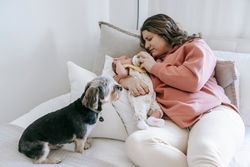
The homecoming: the first introduction
The moment of homecoming is exciting – deliberately keep it calm. Your dog may have been alone or in someone else's care for a day or two and will be beside itself with joy at seeing its people again. So it is best to let someone else hold the baby while you first greet your dog quite normally and calmly and give it the chance to work off that first excitement. Only once it has settled down does the actual introduction follow.
At the first meeting, keep your dog on a loosely hanging lead and let it sniff from a respectful distance – do not push it into anything and never force contact. Reward calm, friendly behaviour with quiet praise and let your dog set the pace. If the first encounter stays relaxed and positive, the foundation for a good relationship is laid. There is no reason to rush: dog and child have many years together from now on.
The golden rule and reading body language
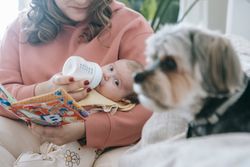
Now for the one rule that stands above all others and must never be broken: never leave a dog and a baby or toddler alone together – not for a single second, no matter how gentle and reliable your dog is. Supervise every single encounter. Whenever you cannot watch – even just to open the door or pop to the toilet – separate the two reliably by space, with a closed door or a child gate. This is the one rule where there is no trust, no exception and no "just for a moment".
Part of supervision is being able to read your dog's body language. Watch for subtle stress signals such as licking over the muzzle, yawning, turning the head away, freezing or a hard, fixed stare – if your dog shows such signs, give it space at once and end the situation calmly. And this is crucial: never punish a growl. A growl is communication, a polite warning – punishing it takes the warning away from the dog and makes the situation more dangerous, not safer. If you notice guarding of food or toys, tension, or you simply feel unsure, get professional help early – your vet is the first port of call and can refer you to a behaviour specialist if needed.
Hygiene and making the baby a good thing
Hygiene needs some thought too, without going overboard. Keep worming and your dog's basic care reliably up to date – some roundworms can pass to children too; you can find out what rhythm makes sense for a household with a baby in our article on worming and in conversation with your vet. Wash your hands after petting, keep the dog away from the changing area and from the baby's face, and do not let it lick the baby – however well meant it is.
For all this caution, it is equally true: do not banish your dog from family life – instead, make the baby a good thing. Make sure nice things always happen when the baby is around – a treat, calm attention, a shared walk, friendly praise. That way your dog learns: when the child is here, things get especially pleasant for me. This positive association is worth its weight in gold and heads off jealousy.
The bottom line: above all it takes calm, patience and an early start – then the vast majority of dogs handle the new arrival remarkably well, and over the years dog and child often become an inseparable team. Amid all the trust, just never forget the one non-negotiable rule: dog and baby are never left unsupervised alone. Those who take this to heart and ease the transition for their dog with time and attention create the best foundation for many happy years together.
Note: this guide offers general orientation and does not replace a veterinary examination or advice. If your dog has a health problem or in an emergency, please consult your vet.