Bite Inhibition in Puppies: Gently Curbing the Nipping
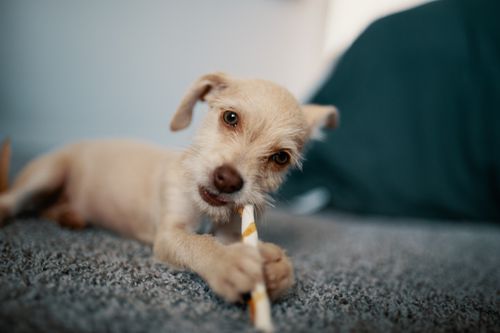
The puppy has barely moved in and hands, sleeves and trouser legs are its favourite target: with sharp milk teeth it nips at every opportunity. Many owners are unsettled and wonder whether their puppy is aggressive. The reassurance first: in the vast majority of cases this is entirely normal puppy behaviour.
The dog should nonetheless learn to use its teeth in a controlled way, because an adult dog with a powerful jaw must no longer nip. That is exactly what bite inhibition is about. This guide explains what it is, why puppies bite and how to teach your puppy, gently and effectively, to control its mouth.
What bite inhibition means
Bite inhibition is a dog's ability to dose the force of its bite and use its mouth in a controlled way. A dog with good bite inhibition knows it must be careful on skin and does not bite hard even when excited or startled. It is one of the most important lessons in a dog's life.
The goal is not to forbid mouthing completely straight away, but to teach the puppy to grip ever more gently, until it no longer touches skin with its teeth at all. A dog that has learned to control its bite force is also much safer in critical situations.
Why puppies bite
Puppies explore the world with their mouths, like toddlers with their hands. Biting is part of their play, their exploration and their communication. Added to this is teething, when the gums itch and chewing brings relief. All of this makes the nipping especially intense in this phase.
It is important to understand that the puppy is not being malicious with this, but living out a completely natural need. Anyone who knows this reacts more calmly and can patiently steer the behaviour in the right direction, instead of misreading it as an attack.

Where puppies learn bite inhibition
The puppy lays the foundation already in the litter. Playing with its siblings, it learns: if I bite too hard, the other yelps and the game stops. That way it discovers quite naturally that gripping too roughly has unpleasant consequences. The mother dog also gives clear feedback here.
This is why it is important that puppies are not separated from litter and mother too early. After the move you continue this lesson by giving, in your interactions with the puppy, the same clear but friendly feedback as its siblings.
How to respond correctly
The most effective method is simple: if the nipping gets too hard, the game ends at once. You can make a short, high sound and then withdraw attention by turning away or briefly leaving the room. The puppy learns: hard teeth end the fun, gentle mouthing may continue.
Stay calm and consistent. Resume the game after a short break, so the puppy can make the connection. Repeat patiently. Over many small learning units, the puppy lowers its bite force further and further, until it only touches skin very gently.
What you should not do
Never hold the puppy's muzzle shut, do not tap or hit it and do not intimidate it. Such methods create fear and mistrust, can damage the relationship and, in the worst case, trigger real defensive behaviour. They are the opposite of helpful.
Also avoid wild play with your hands right at the mouth, which winds the puppy up further. Do not reward wild tugging at clothing with counter-tugging. Instead, steer the energy onto permitted objects the puppy may chew to its heart's content.
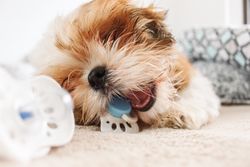
Offering permitted alternatives
A bite-happy puppy needs suitable outlets. Always keep a chew toy and a tug toy at hand and slip them to the puppy at the right moment when it snaps at hands. That way it learns where its chewing need belongs.
Combine this with enough occupation for body and mind. A puppy that is mentally and physically satisfied has less surplus energy, which otherwise discharges in wild nipping. An overview of suitable equipment is in the guide to the puppy starter kit.
Overtiredness as a common cause
An often overlooked reason for especially wild biting is overtiredness. Like an exhausted toddler, an overtired puppy does not become calmer but more frantic and more bite-happy. Many biting fits in the evening are simply a sign that the puppy urgently needs to sleep.
Puppies need a great deal of sleep, often eighteen to twenty hours a day. Provide fixed rest times in a cosy place. When wild nipping takes over, it is often not more training that helps, but simply more rest for the over-wound little dog.
Children and handling the puppy
For children the sharp puppy teeth are especially unpleasant, and children often react with shrieking and wild pulling away, which winds the puppy up further. Show children how to stay calm and end the game when biting gets too hard, instead of wriggling.
Never leave small children and puppies unsupervised and provide clear retreats for both. That way both sides learn a respectful interaction from the start. These basics go hand in hand with good socialisation.
When it goes beyond normal puppy biting
In rare cases the biting is no longer playful but accompanied by real tension, growling with a stiff body or fear. If your puppy bites seriously and with force in certain situations, such as having food taken away, look more closely.
In such cases and if you are unsure, get competent help early. A good dog school or behaviour consultant can assess whether everything is within the normal range and show you how to proceed. The basics of training are in the guide to dog training.
Frequently asked questions
Is it normal that my puppy bites constantly? Yes. Puppies explore with their mouths and bite in play and during teething. The goal is not to forbid it at once, but to control the bite force gradually.
How long until bite inhibition is in place? That is individual and takes weeks of consistent, patient practice. With the end of teething and increasing maturity it usually improves markedly.
May I hold the puppy's muzzle shut? No. That creates fear and harms the relationship. Instead, calmly end the game and offer permitted chewing alternatives.
My puppy bites especially wildly in the evening, why? Usually overtiredness is behind it. Provide fixed rest times. Often more sleep solves the problem better than any training measure.