Loose-Leash Walking: Stopping Your Dog from Pulling
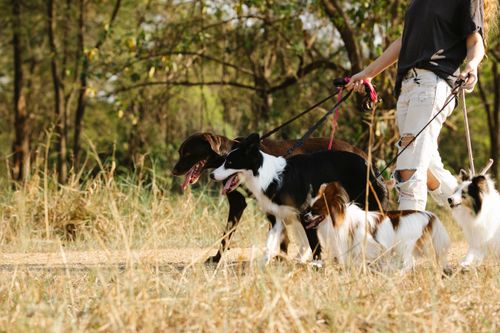
Little spoils a walk as much as a dog that pulls constantly on the leash. Your arm hurts, the dog coughs in its harness, and the relaxed stroll turns into a tug of war. The good news: loose-leash walking is not a character trait but a skill every dog can learn – at any age.
It helps to understand why dogs pull: they are simply faster than us and want to reach the next interesting spot. If pulling gets them there, they learn that pulling pays. This is exactly where good training comes in – we make the loose leash pay more than the tight one.
The right equipment
A well-fitted harness is the best foundation: it spreads the pressure and spares the sensitive neck. Collars that inflict pain when pulling – choke or prong collars – have no place in modern training and are in part legally problematic too. A fixed leash of about two metres gives enough room without the dog constantly running to the end.
The retractable leash is unsuitable for teaching loose-leash walking, because its constant tension trains exactly the opposite. Use it at most later on safe open areas. For training you also need plenty of small, soft treats your dog especially loves.
The core principle: a loose leash pays
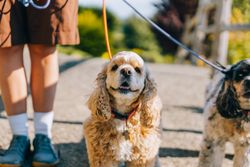
The core is simple: as long as the leash hangs loose, you move forward and there is praise. The moment it tightens, you stop immediately like a tree – no progress. Only when the dog releases the tension and looks at you or comes back do you continue. It learns: pulling brakes, a loose leash reaches the goal.
Alternatively, at every pull change direction and walk the opposite way. The dog has to follow you and learns to pay attention to you instead of charging blindly ahead. Both methods need absolute consistency: letting it “pull just once” sets you back.
Practising step by step
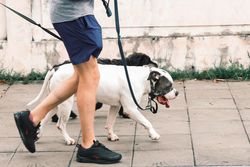
Start in a boring, low-stimulus place – the garden or a quiet street, not in the middle of the bustle. Reward your dog generously when it walks beside you with a loose leash. At first place a marker word or a “yes” at the exact moment the leash hangs loose.
Keep sessions short – five to ten focused minutes are worth more than an hour of frustration. Increase distraction only slowly, once it works reliably in calm places. The general training basics are in the guide Dog training.
Common mistakes
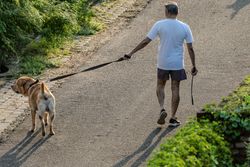
The biggest mistake is inconsistency: sometimes the dog may pull, sometimes not – then it never understands the rule. Equally harmful is jerking sharply on the leash. It creates pain and stress but does not solve the problem, because the dog does not learn what to do instead.
Too much distraction too early also overwhelms. Starting in the busy city centre only collects failures. And finally: rewarding too little. Especially at the start, praise for the loose leash may be generous – after all, you are competing with exciting smells and other dogs.
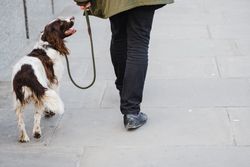
Timing, marker word and rewarding in the right place
Dogs learn through consequences that follow their behaviour immediately. Timing therefore decides success or failure. Reward at the exact moment the leash is loose and your dog walks beside you – not two seconds later, when it is already pulling again. A marker word like “yes” or a clicker bridges the gap: it tells the dog, at the precise instant, “that was right”, and the treat follows shortly after.
Where you reward matters too: ideally at the height of your knee or leg, exactly where you want your dog. Giving the reward in front of your body unconsciously lures the dog forward. Over time it links the position at your side with something good and stays there on its own.
Only reduce the treats once the behaviour is solid – and then gradually, not abruptly. Praise, a friendly word and the freedom to walk on become the real reward bit by bit.

Length, pace and place matter too
Pure training walks are short and focused – but your dog also needs exercise and sniffing time. Deliberately separate the two: on the practice route the loose leash applies; elsewhere it may sniff at length and relieve itself on a long line. That way you and your dog understand when which rules apply, and the training demand overwhelms no one.
Pace helps too: many dogs pull less when the tempo varies – sometimes brisk, sometimes slow, with small changes of direction. This keeps your dog attentive and close to you. A calm, low-stimulus place for the first exercises is worth gold; save the busy city centre for later, once the basics are solid.
Frequently asked questions
My dog only pulls at the start of the walk – why? Excitement is highest at the beginning. Build in a short calm phase before setting off and only start once your dog is responsive. The first few metres often decide the whole walk.
Does an anti-pull harness help? Front-clip harnesses can mechanically dampen pulling somewhat and are a fair transitional aid. They do not replace training – the real solution remains practising the loose leash.
Can I still teach an adult dog? Yes. Loose-leash walking can be learned at any age. In older dogs the relearning sometimes takes a little longer because old habits are more ingrained – with consistency it still works.
How long should a training session last? Short and regular beats long and rare. Five to ten focused minutes per walk are plenty – attention drops off after that anyway. Better a few good minutes daily than one tedious hour once a week.
Sticking with it pays off
Loose-leash walking does not emerge in a week but through many short, positive repetitions. Some dogs get it in a few days, others need weeks – both are normal. What matters is that every walk becomes a small training ground without feeling like drill.
If, despite consistent practice, your dog pulls extremely hard or barks on the leash, guidance from a good dog school is worth it. A reliable recall complements loose-leash walking ideally and gives you both more freedom together.