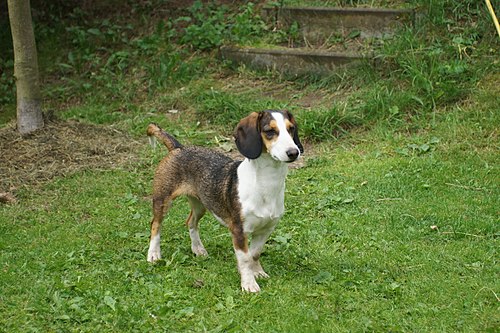
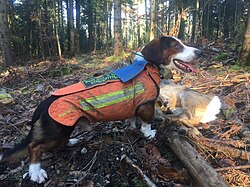
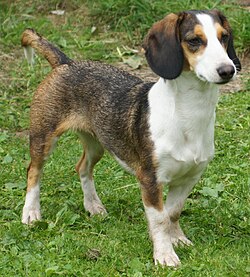
Westphalian Dachsbracke
🧠 Temperament & character
The Westphalian Dachsbracke is cheerful, enduring and, despite her short legs, astonishingly capable. On the trail she shows herself passionate and vocal, while in everyday life she is friendly, affectionate and balanced. She is intelligent, but also headstrong, and follows her nose with devotion. Towards her family she is warm and sociable.
📜 Origin & history
The Westphalian Dachsbracke emerged in Westphalia from the German Hound, by crossing in short-legged, Dachshund-like dogs to obtain a low, agile hound for flushing work. As early as the 19th century she was popular in her homeland as a handy hunting dog for small game. She retained the fine trailing sense of the hound, but housed it in a more compact body. To this day she is a rare breed, kept predominantly for hunting.
✂️ Grooming, care & training
The Westphalian Dachsbracke's short, dense coat is uncomplicated and needs only occasional brushing. Despite her short legs she has a considerable need for exercise, which long walks and above all scent work cover. Because of her long back one should avoid overweight as well as frequent stair-climbing and jumping in order to protect the spine. She is teachable but independent, which is why patience and a recall practised early on are important.
🩺 Health
The Westphalian Dachsbracke is fundamentally robust and reaches an age of about ten to thirteen years. Because of her elongated back, attention must be paid to the spine, as intervertebral disc problems can be an issue, similar to other short-legged breeds. A lean weight and back-friendly exercise are preventive. Reputable breeders select healthy parent animals with good anatomy.
🏡 Who is this breed right for?
The Westphalian Dachsbracke is above all a hunting dog and suits active people or hunters best who cater to her urge to use her nose and to move. In an active home she can certainly be an easy-going family dog, provided she is kept sufficiently occupied. For a stimulus-poor flat life without adequate activity she is unsuited. In Switzerland she is rare and finds a suitable home primarily among hunters.