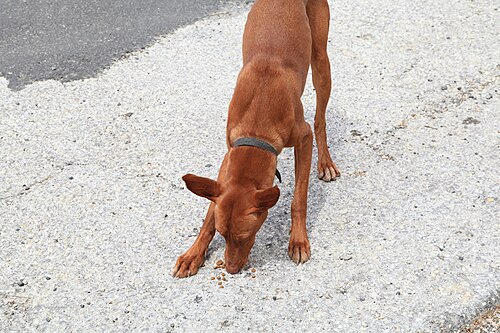
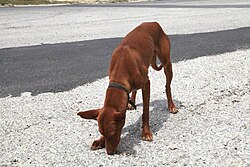
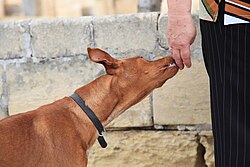
Pharaoh Hound
🧠 Temperament & character
The Pharaoh Hound is intelligent, active and decidedly playful, while being loving towards his family and rather reserved towards strangers. He has a pronounced hunting drive and can dash off in a flash at visual stimuli, which is why a safe environment is important. At the same time he is sensitive and delicate and is easily unsettled by a loud or harsh tone. He usually gets on well with children and compatible dogs, but towards small fleeing animals his hunting instinct stays alert. Whoever meets him with affection and humour gains a cheerful, affectionate companion.
📜 Origin & history
In Malta the Pharaoh Hound has for centuries been used as the 'Kelb tal-Fenek', that is, the 'rabbit dog', for hunting wild rabbits, skilfully combining sight, a fine nose and hearing. His name and his appearance long gave rise to the romantic notion of direct descent from the dogs of the pharaohs. Modern genetic analyses show, however, that he is not an immediate descendant of ancient Egyptian dogs, but an independent Mediterranean hunting dog whose type has been preserved over a long period on the Maltese islands. He became internationally known from the 20th century onwards, when English enthusiasts brought the breed to Great Britain; today he is the national dog of Malta.
✂️ Grooming, care & training
The Pharaoh Hound's short, glossy coat is extremely easy to care for and needs only occasional brushing and the odd bath. As a spirited hunting dog he needs plenty of exercise and the opportunity to run and gallop within a safe setting, supplemented by mental tasks. He is clever and eager to learn, but also independent, which is why short, varied and positive training sessions work best. Because of his short coat and thin layer of fat he gets cold easily and appreciates a coat in cold or wet weather. A well-secured area for running is important, as he can quickly disappear in response to visual stimuli.
🩺 Health
The Pharaoh Hound is considered a remarkably healthy and robust breed with few hereditary problems and a life expectancy of about 12 to 14 years. Like many sighthound-type breeds he reacts sensitively to certain anaesthetics and has a low body-fat percentage, of which the vet should be informed before an operation. Allergies or hip dysplasia occasionally occur, but serious breed-typical hereditary diseases are rare. Reputable breeders pay attention to healthy, temperamentally sound parent animals and have sensible examinations carried out.
🏡 Who is this breed right for?
The Pharaoh Hound suits active, empathetic people and families who are looking for a sporty yet sensitive companion. He can live well in a flat given enough exercise, as he is mostly calm and clean at home, but he needs safe opportunities to run every day. For beginners he is quite suitable with good guidance, provided they accept his hunting drive and his sensitive nature. In Switzerland he suits sporty owners who can, for example, get him enthusiastic about coursing or long runs, create good recall situations and grant him a coat in cold weather.