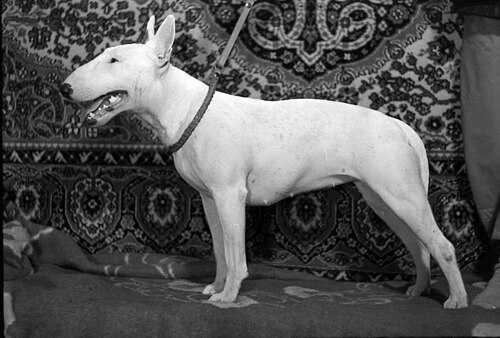

Bull Terrier
🧠 Temperament & character
The Bull Terrier is courageous, even-tempered and decidedly playful - not for nothing is he regarded as the 'clown' among dogs. At the same time he is stubborn and spirited and has a strong prey drive, which is why he needs loving consistency, clear rules and good socialisation. He is very people-oriented and affectionate and does not cope well with being left alone a great deal. With other dogs and small animals caution is advised, but with well-managed socialisation he can be an agreeable companion.
📜 Origin & history
The Bull Terrier emerged in the mid-19th century in England, when bulldogs were crossed with now-extinct terriers to create an agile, powerful dog for dog fighting and rat hunting. The dog enthusiast James Hinks refined the type around 1860 and bred the elegant, all-white 'White Cavalier', from which the modern Bull Terrier arose. After the banning of animal fights he changed into a show and companion dog, in the course of which the striking, convexly curved head developed. Today he is a pure family and companion dog with an unmistakable appearance.
✂️ Grooming, care & training
The Bull Terrier's short, hard and glossy coat is very easy to care for and needs only occasional brushing; he sheds moderately, above all during the moult. More important than coat care is physical and mental exercise: he needs brisk daily walks, play and tasks that challenge him, otherwise he can be inclined to destructiveness or compulsive behaviour. As a powerful, stubborn dog he needs consistent, positive training from the outset and early, thorough socialisation. His pale skin is sensitive to the sun, which is why white Bull Terriers should be protected from strong sunlight.
🩺 Health
In the Bull Terrier several serious hereditary diseases are known, above all deafness, which occurs especially in pure-white animals and can be checked by a BAER test. Equally important are heart disease (above all mitral valve problems) and hereditary kidney inflammation (nephritis), which, untreated, can lead to kidney failure. Added to this are skin problems and allergies, as well as primary lens luxation in the Miniature Bull Terrier. Reputable breeders have the heart, kidneys (by means of a UPC test) and hearing examined and select only healthy parent animals; life expectancy is around eleven to fourteen years.
🏡 Who is this breed right for?
The Bull Terrier is a dog for experienced, consistent owners who bring plenty of time, affection and clear leadership and do not keep him purely as a status or guard dog. He can be a wonderful family dog, but he needs careful socialisation and supervision around small children and other animals. For a flat he is suitable given sufficient exercise, as he is fairly calm at home, but his close bond to people makes a lot of shared time essential. In Switzerland the cantonal legal situation must absolutely be observed, as in many places he requires a permit and in part conditions such as a proof of competence or a leash and muzzle requirement apply.