
Yorkshire Terrier
🧠 Temperament & character
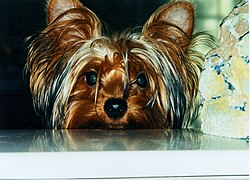
The Yorkshire Terrier is courageous, lively and watchful – a self-confident little dog with the headstrongness typical of a terrier. He is very attached to his family, but often far more spirited and intrepid than his dainty appearance suggests: a true terrier, not a mere little lapdog. Towards strangers he is attentive and gives reliable warning, which makes him a good little guardian. If he is treated like a dog and not like an accessory, and trained consistently, he is a clever, faithful companion.
📜 Origin & history
The Yorkshire Terrier emerged in the 19th century in the industrial north of England, in the counties of Yorkshire and Lancashire. Scottish weavers and workers brought various small terriers with them, from which a tough rat-catcher for factories, mines and stables was bred. From the former working-class dog, a fashionable companion of high society quickly emerged in Victorian England. Despite his transformation into an elegant lapdog, the Yorkie has preserved his courageous terrier heart to this day.
✂️ Grooming, care & training
The Yorkshire Terrier's silky, continuously growing coat is high-maintenance: at full length it must be brushed daily to avoid matting; many owners therefore opt for a practical, shorter cut. The Yorkie barely sheds and is considered comparatively suitable for allergy sufferers. In terms of exercise he is less demanding than large terriers, but he still needs daily walks, play and mental occupation. It is important to take him seriously and train him consistently – small dogs too need clear rules. Dental and mouth hygiene deserve particular attention in this breed.
🩺 Health
The Yorkshire Terrier is remarkably long-lived, with a life expectancy of around 13 to 16 years, but is prone to some breed-typical problems. Common are patellar luxation (dislocation of the kneecap), dental and gum diseases due to the small jaw, and tracheal collapse (collapse of the windpipe) – which is why a harness rather than a collar is advisable. The portosystemic liver shunt also occurs. Responsible breeders pay attention to healthy breeding animals and an appropriate size rather than extreme tininess.
🏡 Who is this breed right for?
Thanks to his small size, the Yorkshire Terrier is an ideal companion for flats, the city and people looking for a small, adaptable dog. He suits singles, seniors and families with older, careful children – for small children he is less suitable because of his fragility. He is also an option for first-time owners, provided they raise him as a fully-fledged dog and do not pamper him. In Switzerland he is a practical everyday companion who can be taken anywhere, needing little space but genuine occupation.