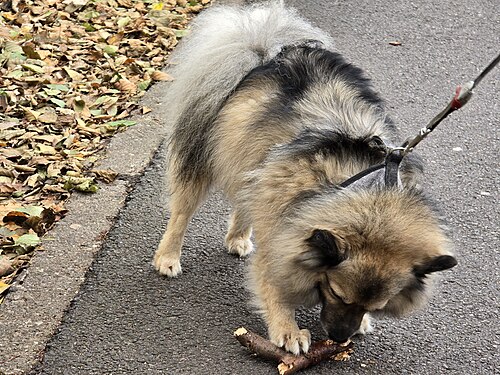
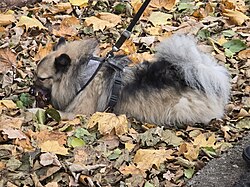
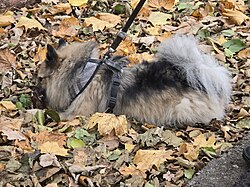
Keeshond (Wolfsspitz)
🧠 Temperament & character
The Keeshond is attentive, lively and extremely affectionate, an alert watchdog without sharpness and entirely without prey drive. He bonds very closely with his family, is cuddly and wants to be part of everything, which is why he does not like being left alone for long. As a typical spitz he is fond of barking and reliably raises the alarm, something that should be channelled into calm paths early on. With children and other dogs he usually gets on excellently and shows himself to be friendly and sociable. He is intelligent, willing to learn and sensitive, so that he responds particularly well to friendly, appreciative training.
📜 Origin & history
The Keeshond belongs to the old family of European spitzes and for centuries was at home on farms as well as on the barges of the Dutch rivers and canals as an alert guardian. In the Netherlands, under the name Keeshond, he became in the 18th century the symbol of the patriotic movement that was named after its leader and his dog. After the political upheaval the breed was temporarily in difficulty, but was preserved and bred on by enthusiasts in Germany and the Netherlands. Today the Wolfsspitz and Keeshond, as the largest German Spitz, are a recognised breed and popular family dogs.
✂️ Grooming, care & training
The Keeshond's lush, double coat with its lion-like ruff looks like a lot of work, but is surprisingly easy to care for and mainly needs regular brushing, once to several times a week, which is enough to keep it looking good. During the twice-yearly heavy moult it must be brushed more often; he should never be clipped, as the coat also protects him from heat. He needs daily exercise in the form of walks and play as well as mental occupation, but is not an extreme athlete and adapts flexibly. He is very willing to learn and sensitive, which is why he can be trained wonderfully with positive methods, and his barking behaviour should be gently steered from an early age.
🩺 Health
The Keeshond is considered a fundamentally robust, long-lived breed with a life expectancy of around 12 to 15 years. Known health issues include patellar luxation, hip dysplasia and primary hyperparathyroidism (PHPT), a hereditary disorder of calcium metabolism for which a genetic test exists. Responsible breeders test for PHPT, have the knees and hips examined and pay attention to healthy, temperamentally sound parent animals. As with all spitzes, keeping an eye on weight and regular exercise is also important to keep the joints and cardiovascular system healthy.
🏡 Who is this breed right for?
The Keeshond suits people and families who are looking for an affectionate, people-oriented companion dog and want to spend a lot of time with him. Since he is very fixated on his family, he is ill-suited to long periods of being alone, but all the better suited to an active, sociable household. He can live well in an apartment, provided his barking behaviour is steered early and he is given enough exercise and closeness; a garden is nice, but not a must. For beginners he is well suited thanks to his friendly, willing-to-learn nature, and in Switzerland he cuts an excellent figure as a loyal, alert family dog for walks, hikes and dog sports.