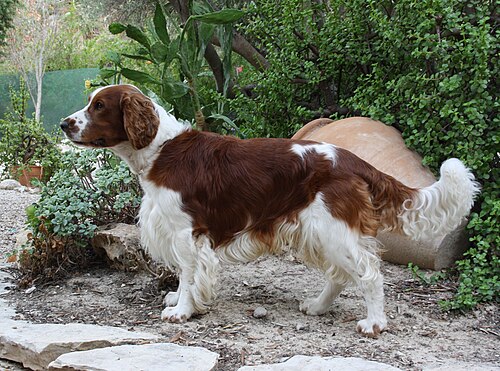
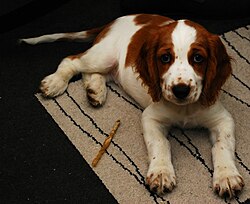
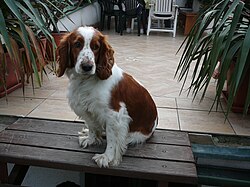
Welsh Springer Spaniel
🧠 Temperament & character
The Welsh Springer Spaniel is friendly, work-loving and enduring, while being affectionate and eager to learn. Towards strangers he is somewhat more reserved than the English Springer, but warms up with good socialisation. He is strongly oriented towards his family and wants to be closely involved. With motivating, clear training he is a cooperative, cheerful partner with lots of energy.
📜 Origin & history
The Welsh Springer Spaniel is an old breed from Wales, whose red-and-white spaniels were already used for hunting in the region centuries ago. For a long time he was regarded as a variety of the English Springer, but was recognised as a separate breed at the beginning of the 20th century. He was valued as a versatile flushing and retrieving dog for feathered game that also works enduringly in difficult terrain. To this day he is rarer than his English relative, but has loyal enthusiasts.
✂️ Grooming, care & training
The Welsh Springer Spaniel's dense, silky red-and-white coat with its feathering needs regular brushing and occasional trimming; the drop ears must be checked and kept dry. His need for exercise is high: he needs plenty of daily exercise, nose work and ideally a hunting or sporting task. Mental occupation is just as important as physical. He is eager to learn and easy to handle and likes to work closely with his person.
🩺 Health
The Welsh Springer Spaniel is considered a comparatively robust breed with a pleasingly high life expectancy of around 12 to 15 years. Hip dysplasia, hereditary eye diseases such as glaucoma and cataract as well as ear infections favoured by the drop ears can occur. Responsible breeders examine the hips and eyes of the parent animals and pay attention to a healthy, balanced nature.
🏡 Who is this breed right for?
The Welsh Springer Spaniel suits active people and families who offer him plenty of daily exercise and a task and appreciate a somewhat more reserved but loyal dog. For athletic first-time owners he is manageable, provided they take his energy and his need for close bonding seriously. Ideal is a nature-close home, preferably with a garden, but given sufficient occupation active apartment keeping is also possible. Early socialisation helps him to shed his initial reserve towards strangers.