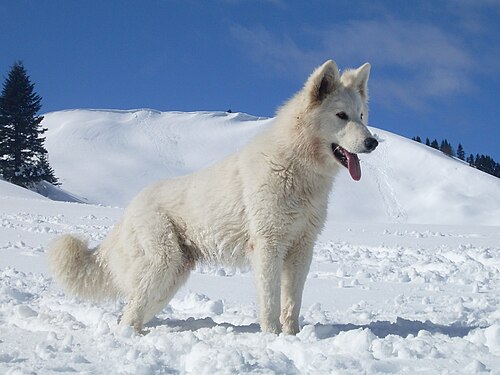
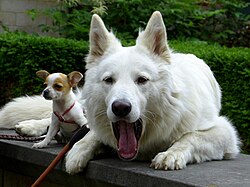
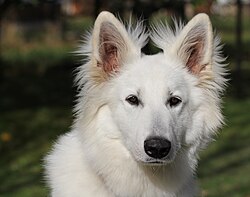
White Swiss Shepherd Dog
🧠 Temperament & character
The White Swiss Shepherd Dog is regarded as intelligent, attentive and extremely eager to learn. Compared with the German Shepherd he is usually softer, more sensitive and more dependent on a close bond. He is fond of children, sociable and generally good with other dogs, though he can be reserved with strangers. As an attentive dog he shows watchfulness without being excessively sharp. His sensitivity means that he responds poorly to loud or harsh training.
📜 Origin & history
White shepherd dogs already existed among the first German Shepherds, but the white coat colour later became undesirable in their breeding. The type survived by way of North America and returned from there to Europe, where it was consistently bred on in Switzerland. In 1991 the White Swiss Shepherd Dog was entered in the Swiss studbook and later recognised by the FCI as a breed in its own right – with Switzerland as the country of origin.
✂️ Grooming, care & training
The white double coat – short or long-stock-haired – is surprisingly easy to care for, but sheds heavily on a seasonal basis and should then be brushed more often. As an active herding dog the White Swiss Shepherd Dog needs plenty of exercise as well as mental work such as scent work, obedience or agility. Thanks to his great willingness to learn he is very easy to train and enjoys working together with his person. Early socialisation and a loving, consistent, never harsh approach are important.
🩺 Health
The White Swiss Shepherd Dog is regarded as a predominantly healthy breed with a life expectancy of around twelve to fourteen years. As with many medium to large dogs, hip and elbow dysplasia can occur, which is why reputable breeders have their animals x-rayed. Degenerative myelopathy and gastrointestinal sensitivities occasionally occur. Look for parent animals with good joint results and a stable, non-anxious temperament.
🏡 Who is this breed right for?
The White Swiss Shepherd Dog is a good fit for active families, couples and also open-minded first-time owners who are prepared to spend a lot of time with their dog. He prefers living in a house with a garden to a small city apartment, but can be happy anywhere as long as he gets enough exercise and close family contact. Because of his sensitivity he needs a calm, fair environment and should not be left alone much. In Switzerland he is especially popular and widespread as a native breed.