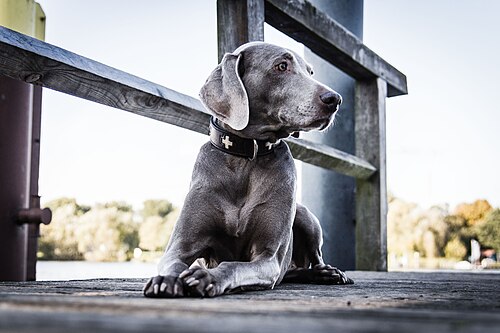
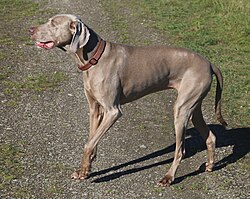
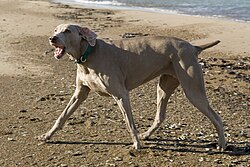
Weimaraner
🧠 Temperament & character
The Weimaraner is self-assured, intelligent and exceptionally people-oriented – it always wants to be near its family. It is brave, spirited and eager to work, but can also be headstrong and assertive. It copes poorly with being left alone for long and then tends towards separation stress. Its pronounced hunting and prey drive as well as its sensitivity call for consistent but fair leadership.
📜 Origin & history
The Weimaraner arose in the 19th century at the court of Weimar, where the nobility wanted a distinguished, versatile hunting dog for work on big game and feathered game. There are various theories about its exact ancestry, but the striking grey colour was deliberately encouraged from the outset. For a long time the Weimaraner club kept breeding strictly under control, which contributed to the exclusivity of the breed. Today the Weimaraner is known worldwide as an elegant pointing dog and companion.
✂️ Grooming, care & training
The short-haired Weimaraner is exceptionally easy to care for and needs only occasional brushing; alongside it there is a rarer long-haired variety. Far more important is keeping it occupied: this dog needs a great deal of daily exercise and demanding mental work, otherwise it quickly becomes unbalanced. Nose work, retrieving, tracking and dog sports challenge its keen mind. In training it needs clear rules from the start, consistency and a close, trusting bond.
🩺 Health
The Weimaraner's life expectancy is around 11 to 13 years. As a large, deep-chested breed it is particularly prone to life-threatening gastric torsion; hip dysplasia also occurs. Reputable breeders have the hips X-rayed and pay attention to healthy, temperamentally sound lines. Rest after eating and meals spread over the day help to lower the risk of gastric torsion.
🏡 Who is this breed right for?
The Weimaraner suits active, consistent and dog-experienced people who can devote plenty of time to exercise, training and closeness. For beginners, working people with little time or pure apartment living it is hardly suitable – it makes physical as well as mental demands on its owners. In Switzerland it is an enthusiastic companion for hunting, hiking, jogging and demanding dog sports. With its own family's children it gets along well, but its temperament should be kept an eye on around small children.