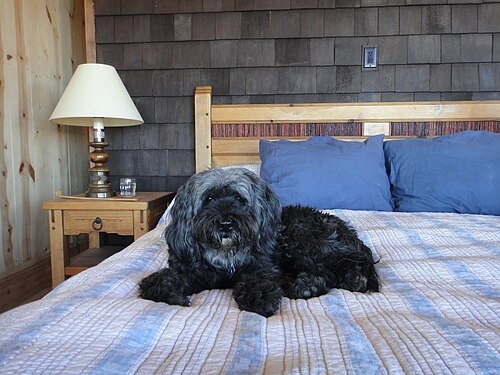
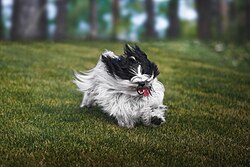
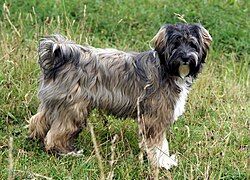
Tibetan Terrier
🧠 Temperament & character
The Tibetan Terrier is intelligent, watchful and loyal, and good-natured and playful within the circle of his family. Towards strangers he is rather reserved and attentive, which makes him a reliable alarm-giver. He is sensitive and trainable, but also shows the independence typical of monastery dogs and a certain stubbornness. With children and other animals he usually gets on well given good socialisation.
📜 Origin & history
The Tibetan Terrier has been kept for around two thousand years in the monasteries and farms of Tibet, where he served as a guardian, herding helper and companion. The monks regarded him as a sacred bringer of luck and never sold him, but gave him away only as a token of esteem. At the beginning of the 20th century a British doctor brought the first animals to Europe after she had received a Tibetan Terrier as a thank-you gift. From there the breed spread and became a popular family and companion dog.
✂️ Grooming, care & training
The Tibetan Terrier's long, dense double coat calls for brushing several times a week, even daily during the coat change, to avoid matting. He is an active, enduring dog that needs long daily walks, exploration and mental occupation every day. As a clever but independent dog he learns well, but calls for varied, motivating training rather than monotonous repetition. Thanks to his origin in the mountains he loves rough terrain and is a reliable hiking companion.
🩺 Health
The Tibetan Terrier is basically robust and often reaches an age of twelve to fifteen years. Hereditary risks include PRA (progressive retinal degeneration), lens luxation, hip dysplasia and neuronal ceroid lipofuscinosis (NCL), a serious hereditary disease for which a genetic test is available. Responsible breeders DNA-test their breeding animals for NCL and PRA, X-ray the hips and have the eyes examined. Buying from a breeder who carries out these health examinations is therefore especially important.
🏡 Who is this breed right for?
The Tibetan Terrier is suited to active families, couples and individuals looking for an intelligent, medium-sized companion capable of hiking. He copes in a larger apartment as well as in a house with a garden, as long as he gets enough exercise and mental occupation. For first-time owners he is suitable if they are willing to invest in coat care, occupation and consistent training. In Switzerland he is an ideal companion for hiking and nature lovers who value a weatherproof, loyal dog.