Sussex Spaniel
🧠 Temperament & character
The Sussex Spaniel is calm, good-natured and somewhat stubborn, while friendly and affectionate towards his family. He is a slow, deliberate worker who likes to give tongue on the hunt – and he can be quite talkative in everyday life too. He is less exuberant than other spaniels and seems relaxed, but definitely has a mind of his own. With patient, motivating training he is a pleasant, loyal companion.
📜 Origin & history
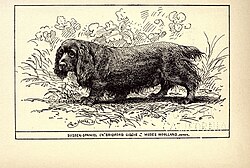
The Sussex Spaniel has been bred since the late 18th century in the English county of Sussex, above all on the Rosehill Park estate. What was sought was a powerful, enduring flushing dog for heavy, dense terrain, one that gives tongue at work so that hunters can follow him. The breed was always rare and survived the world wars only thanks to a few dedicated breeders with a very small gene pool. To this day it is one of the rarest and most endangered British dog breeds.
✂️ Grooming, care & training
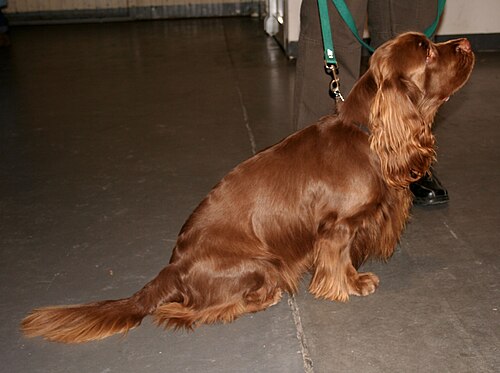
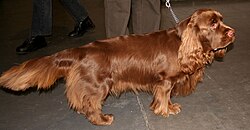
The Sussex Spaniel's dense, silky golden-brown coat with its feathering needs regular brushing and occasional stripping; the long pendulous ears must be checked and kept dry. His need for exercise is moderate: extended but calm walks and scent work are enough, and extreme exertion is not necessary. He is inclined to put on weight, which is why controlled feeding is important. As a somewhat stubborn dog he needs patient, motivating training.
🩺 Health
The Sussex Spaniel usually reaches an age of around 11 to 13 years, but as a very rare breed with a small gene pool he is prone to a number of problems. Conditions that can occur include hip dysplasia, congenital heart defects such as the patent ductus arteriosus (PDA), intervertebral disc problems due to the long back, and ear infections encouraged by the pendulous ears. Responsible breeders examine the heart, hips and eyes and use the available genetic test against PDP1 deficiency.
🏡 Who is this breed right for?
The calm, easy-going Sussex Spaniel suits families and quieter people who value a relaxed, good-natured dog without a high urge to move. He is also suited to attentive first-time owners and can live in an apartment given sufficient walks, provided one accepts his talkative manner. Patience in training and controlled feeding are important. Because of his great rarity it takes a lot of patience and often an international search to find a reputable breeder.