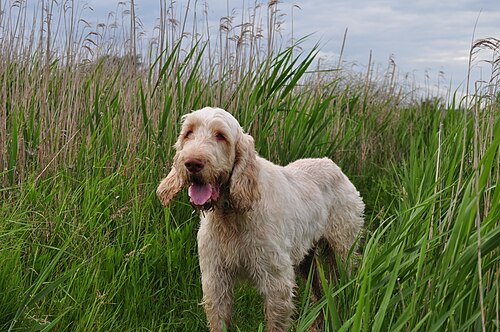

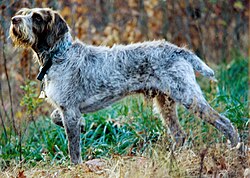
Spinone Italiano
🧠 Temperament & character
The Spinone Italiano is gentle, patient and exceptionally sociable – it seeks close company and likes to be part of the family. In the field it works enduringly, but leisurely and deliberately, without the haste of many other pointing dogs. It is compatible with children, other dogs and strangers and is considered particularly people-oriented. This calm, friendly manner makes it a pleasant companion in everyday life.
📜 Origin & history
The Spinone Italiano has ancient roots and is one of the oldest pointing breeds of all; similar wire-haired dogs have been documented in Italy since antiquity. For centuries it was the preferred hunting dog in the marshy and mountainous regions of northern Italy, especially in Piedmont. After the Second World War the breed was on the brink of extinction, but was preserved by dedicated enthusiasts. Today the Spinone is valued worldwide as a versatile hunting and family dog.
✂️ Grooming, care & training
The Spinone Italiano's rough, wiry coat with beard and eyebrows needs regular brushing and occasional stripping, but sheds little. As an enduring, if leisurely, hunting dog it needs extensive daily exercise, preferably with nose and water work. It is intelligent and eager to learn, but reacts sensitively to harshness and needs patient, friendly guidance. Its beard often becomes damp after eating and drinking and should be cleaned occasionally.
🩺 Health
The life expectancy of the Spinone Italiano is around 11 to 13 years. As a large, deep-chested breed it is prone to gastric torsion; in addition, hip and elbow dysplasia as well as the hereditary cerebellar ataxia of the Spinone occur. Reputable breeders use the DNA test for cerebellar ataxia and have hips and elbows X-rayed. Rest after eating and meals spread over the day lower the risk of gastric torsion.
🏡 Who is this breed right for?
The Spinone Italiano suits active families and people who are looking for a calm, sociable and yet exercise-loving companion. Thanks to its gentle, patient nature it is well suited to households with children and also to sensitive first-time owners. It needs close company and does not like to be left alone – in Switzerland it is a great partner for hikes and nose work. For keeping purely in an apartment without exercise it is nevertheless not made.