Schipperke
🧠 Temperament & character
Lively, curious and decidedly alert, the Schipperke is a bold and self-confident little dog with the temperament of a much larger guardian. He bonds closely with his family, is playful and eager to learn, but announces anything unfamiliar loudly and is initially suspicious of strangers. His pronounced hunting and prey drive and his spirited nature call for consistent training and plenty of activity. When well socialised he is a loyal, entertaining companion who should never be under-challenged.
📜 Origin & history
The Schipperke comes from Belgium, where in the 19th century he was a popular little guard and rat-catching dog on the barges of the canals as well as in the workshops and yards of craftsmen. His name means roughly 'little boatman' in Flemish, or is traced back to 'scheper' (shepherd). He is regarded as a close relative of the likewise Belgian Leuvenaar, from whose smaller strain he emerged. To this day the Schipperke has retained his alert, spirited nature as an attentive companion dog.
✂️ Grooming, care & training
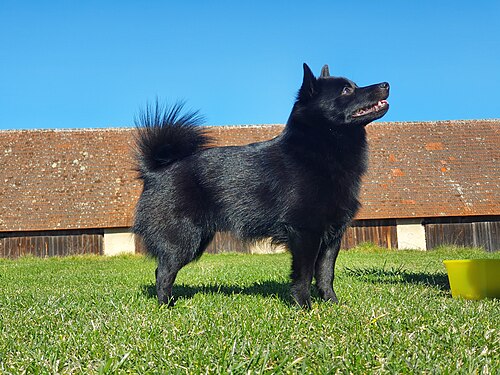
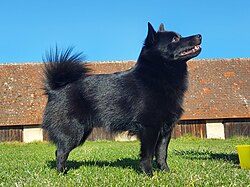
The Schipperke's dense, off-standing black coat with its typical mane and ruff is surprisingly easy to care for; regular brushing suffices, though during the moult, which happens two to three times a year, he sheds plenty of undercoat. Despite his small size he is an energetic dog that needs daily exercise, play and mental challenges. Thanks to his intelligence and eagerness to learn he is well suited to trick training, agility or scent games. Early, consistent training helps channel his alert barking and his hunting drive into orderly paths.
🩺 Health
The Schipperke is considered a robust and long-lived breed that often reaches thirteen to fifteen years or older. The most significant breed-typical hereditary disease is the metabolic disorder MPS IIIB (a form of mucopolysaccharidosis), which leads to progressive neurological decline but can be reliably avoided thanks to a genetic test. Responsible breeders test their breeding animals for MPS IIIB; alongside this, patellar luxation or hypothyroidism occasionally occur. Overall the little Belgian is a tough, healthy dog with a long life expectancy.
🏡 Who is this breed right for?
The Schipperke is a good match for active people and families looking for a small but spirited and alert dog and able to keep him sufficiently occupied. Thanks to his size he is also suited to apartment life, provided his need for exercise and his barking behaviour are addressed early on. For open-minded beginners he is suitable with a little consistency, but should not be misunderstood as a convenient lapdog. In Switzerland the robust, weatherproof little guardian is an attentive companion for walks, dog sports and a lively home.