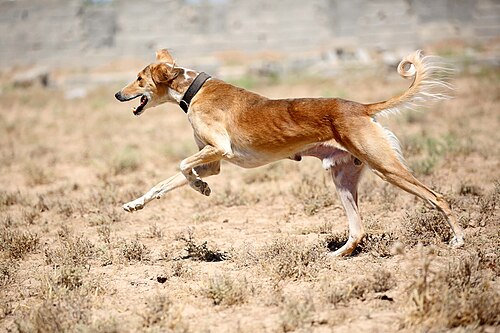

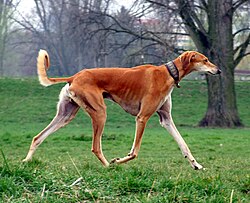
Saluki
🧠 Temperament & character
The Saluki is gentle, sensitive and marked by a quiet independence reminiscent of a cat. To his people he builds a deep but unobtrusive bond, while towards strangers he often remains distant and reserved. Indoors he is calm and balanced, but as soon as something moves, his extremely high hunting drive awakens – then he is hardly responsive any more. He is dignified and sensitive and can be neither pushed nor trained with harshness.
📜 Origin & history
The Saluki has accompanied humankind for thousands of years; depictions of sighthound-like dogs are found as early as ancient Egyptian and Mesopotamian sites. Among the nomadic peoples of the Middle East he was regarded as a precious possession, used together with the falcon to hunt gazelle and hare. As the only dog he was allowed to sleep in the Bedouins' tent and was never sold, only given as a gift. Brought to Europe by British travellers at the beginning of the 20th century, he is today kept above all as a companion and coursing dog.
✂️ Grooming, care & training
The Saluki comes in two variants – smooth-haired or with silky feathering on the ears, tail and legs – but both are pleasantly easy to care for and need only occasional brushing. As a desert sighthound he is built for movement and needs extensive exercise with the opportunity to gallop at full speed, ideally on well-secured ground. His alert mind wants to be occupied, but classic drilling is not for him: he learns best through patience, motivation and mutual respect. A reliable recall is hardly ever fully achievable because of the enormous hunting drive, which is why free running needs to be well considered.
🩺 Health
With a life expectancy of about 12 to 14 years, the Saluki is considered a fundamentally robust and long-lived breed. Like all sighthounds he reacts sensitively to anaesthetics, which the vet must absolutely take into account. Occasionally heart conditions as well as hypothyroidism and certain types of cancer occur. Responsible breeders have the heart, eyes and thyroid examined and pay attention to a solid health foundation in the parent animals.
🏡 Who is this breed right for?
The Saluki is not a beginner's dog: he suits calm, patient people who respect his independence and can offer him plenty of daily exercise. A house with a well-fenced garden is ideal, for his hunting drive makes him an escape artist; for a pure city apartment without safe running ground he is less suitable. With calm, respectful children he gets on well, but hectic environments are nothing for him. Anyone who values the fine, reserved manner of this oriental sighthound and gives him room to run gains an exceptionally graceful companion.