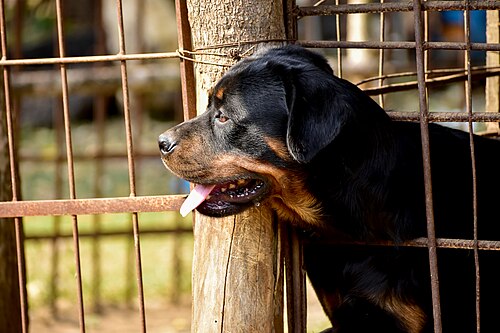
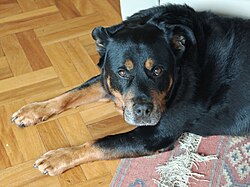
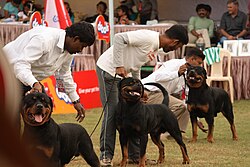
Rottweiler
🧠 Temperament & character
At his core the Rottweiler is a calm, self-assured and courageous dog, devotedly loyal to his family and markedly affectionate with them. He possesses a natural protective instinct and a certain serenity, does not react frantically, but can appear very determined when he sees his pack threatened. Towards strangers he is initially waiting and observant, by no means aggressive without cause – solid socialisation and a composed handler are decisive. He is intelligent, willing to learn and eager to work, but needs clear, fair leadership without harshness so that his stable temperament can fully develop.
📜 Origin & history
The Rottweiler owes his name to the Württemberg town of Rottweil, a former Roman trading post, where he worked for centuries as a droving and butcher's dog. His ancestors probably go back to the droving and guard dogs of the Roman legions that accompanied the cattle across the Alps. He drove cattle herds, guarded the livestock and carried the butchers' purse safely on his collar – hence the nickname 'Rottweil butcher's dog'. With the arrival of the railway he lost his original task, but was rediscovered at the start of the 20th century as a police and service dog and has since been regarded as a classic service-dog breed.
✂️ Grooming, care & training
The Rottweiler's short, dense coat is extremely easy to care for and needs only occasional brushing, a little more frequently during the coat change. As a powerful, intelligent dog he needs plenty of daily exercise and, above all, mental occupation – long walks, pulling and tracking work, obedience or targeted obedience training keep him content. He is keen to learn and eager to work, but calls for calm, consistent and fair leadership without harshness so that he uses his strength and self-confidence positively. Early, thorough socialisation and solid basic training are absolutely central with this powerful breed.
🩺 Health
Unfortunately the Rottweiler has a comparatively short life expectancy of about 8 to 10 years and is prone to some serious diseases. These include hip and elbow dysplasia, malignant bone cancer (osteosarcoma), heart diseases such as aortic stenosis, and the life-threatening gastric torsion. Responsible breeders X-ray hips and elbows, have the heart examined cardiologically and select strictly for health and a stable temperament. A lean weight, moderate growth and regular veterinary checks are important to give this powerful dog as long and healthy a life as possible.
🏡 Who is this breed right for?
The Rottweiler belongs in the experienced, composed hands of people who can lead a powerful dog calmly and fairly and consistently provide him with socialisation, training and occupation. Ideal are a house with a garden and the willingness to invest time in training and shared activities; for beginners, insecure people or a pure city apartment without a task he is less suitable. In several Swiss cantons the Rottweiler is subject to a permit or registration requirement, which is why the cantonal regulations must be checked before acquisition. Well led and socialised, he is a loyal, temperamentally sound family and companion dog.