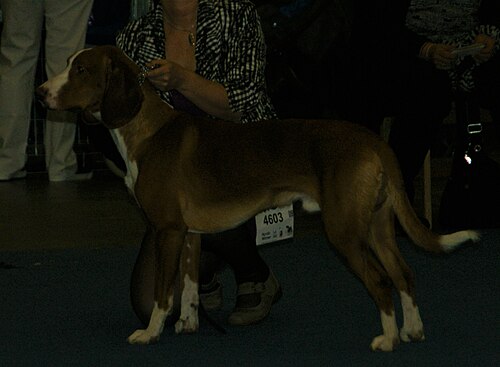
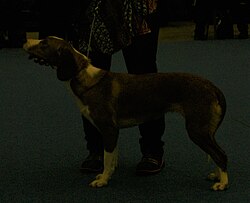
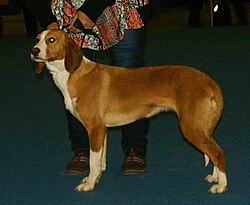
Posavac Hound
🧠 Temperament & character
The Posavac Hound is mild, friendly and even-tempered, one of the gentlest of the Balkan scent hounds. It bonds closely with its people and is affectionate and patient towards them. On the hunt it shows stamina, a fine sense of smell and a sonorous voice with which it follows the trail loudly. Towards strangers it is rather reserved, without being shy or aggressive.
📜 Origin & history
The Posavac Hound comes from the fertile valley of the Sava (Croatian Posavina) in the north of Croatia, where it has been used for hare hunting for centuries. It is one of the tradition-rich Croatian hunting breeds and was recognised by the FCI in 1955, which lists it under No. 154. Its breeding is closely linked to the rural hunting culture of the region. Outside Croatia and the neighbouring countries it is hardly known.
✂️ Grooming, care & training
The Posavac Hound's short to medium-length, dense coat is uncomplicated and needs only regular brushing. As a work-loving hunting dog it needs plenty of exercise and extensive nose work to be content and balanced. Thanks to its gentle, cooperative nature it is easy to train in a friendly way and without harshness, but its hunting drive requires safe terrain and patient recall training. Its loud hunting voice should be kept in mind when keeping it.
🩺 Health
The Posavac Hound is a robust, naturally bred hunting breed with a life expectancy of about twelve to thirteen years; serious breed-typical hereditary diseases are hardly documented. It owes its sound constitution to centuries of selection for hunting performance. As with all drop-eared scent hounds, the ears are to be checked regularly and kept dry. Responsible breeders rely on healthy, temperamentally stable and hunting-tested parent animals.
🏡 Who is this breed right for?
The Posavac Hound is above all a hunting dog, but thanks to its particularly mild nature it is also suitable for active families that can offer it enough exercise and tasks. A rural home with a secured garden suits it better than a city apartment without exercise. It is patient with children and compatible with other dogs, but requires owners who take its hunting and exercise drive seriously. In Switzerland it is a rarity and found practically only in a hunting context.