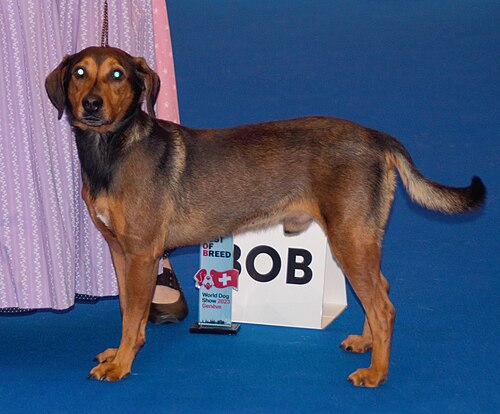
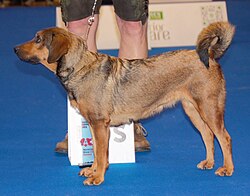
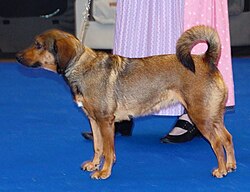
Austrian Pinscher
🧠 Temperament & character
The Austrian Pinscher is lively, attentive and devoted to its family, but at first reserved and suspicious towards strangers — an alert watchdog with distinct territorial behaviour. He is playful and loving within his circle of people, but can also be stubborn and self-assured and needs clear direction. His strong guarding and protective instinct requires early socialisation so that he does not bark excessively or become distrustful. With other dogs he usually gets on well if well socialised, but his original hunting instinct should not be underestimated.
📜 Origin & history
The Austrian Pinscher developed from the old country pinschers, which for centuries lived unspecialised on farms throughout Austria and served as rat and mouse catchers as well as farm and guard dogs. At the beginning of the 20th century, Emil Hauck began systematically collecting these original farm dogs and recording them as a breed; in 1928 it was officially recognised. After the world wars the breed was repeatedly on the brink of extinction and had to be laboriously rebuilt from a few typical farm dogs. To this day the Austrian Pinscher is very rare and is regarded as a living piece of Austrian rural culture.
✂️ Grooming, care & training
The Austrian Pinscher's short to medium-length, dense double coat is exceptionally easy to care for: occasional brushing is enough, a little more often during the moult. As an active farm dog that loves to run, he needs sufficient daily exercise and loves to have a task — whether as a guard, in dog sports or on extended roaming trips. Mental stimulation through search games, tricks or thinking tasks keeps the intelligent dog content. In training, consistency, patience and fair, clear leadership are needed, as he definitely shows a will of his own.
🩺 Health
As an original country breed that has not been over-bred, the Austrian Pinscher is considered remarkably robust and healthy, with a life expectancy of about 12 to 14 years. Breed-typical hereditary conditions are hardly known, which is due to the broad, functional gene pool of the farm dogs. Because of the very small population, responsible breeders pay particular attention to genetic diversity and to the general health and stable temperament of their breeding animals. Species-appropriate keeping with plenty of exercise and a balanced diet supports his natural vitality.
🏡 Who is this breed right for?
The Austrian Pinscher is ideally suited to active people and families with a house and garden or in a rural setting, where he can pursue his guardian role and let off steam. He needs owners who offer him structure, occupation and loving consistency — for pure city apartments without a task he is less suitable, as his need to guard and to move would then be neglected. Experienced first-time owners with time and an interest in an original breed get on well with him. In Switzerland he is a real rarity that appeals above all to lovers of down-to-earth, healthy country dogs.