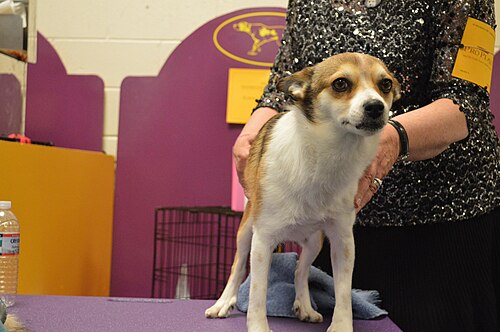
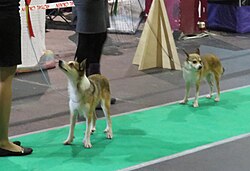
Norwegian Lundehund
🧠 Temperament & character
The Lundehund is bright, lively and attentive, but often shows himself reserved towards strangers and needs time to build trust. Towards his family he is very affectionate and cuddly. His pronounced self-will and his cleverness can make training a test of patience; he is stubborn not out of malice, but because he likes to decide for himself. With other dogs he usually gets on well, and properly socialised he is also a nice playmate for older children. Anyone who keeps him should bring humour and plenty of sensitivity.
📜 Origin & history
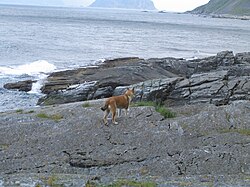
The Lundehund comes from remote islands off the Norwegian coast, where for centuries he was used to catch puffins (Norwegian 'lunde') in their rock niches. His six toes, the mobile ears and the extreme flexibility are adaptations for climbing in narrow, damp cliff caves. When bird-catching went out of fashion and a distemper epidemic in the 1940s wiped out almost the entire population, only a handful of animals survived. From these few dogs the breed was laboriously rebuilt, which is why it remains rare to this day and has a very small gene pool.
✂️ Grooming, care & training
The short to medium-length, dense double coat of the Lundehund is uncomplicated and needs only regular brushing, a little more often during the moult. He is an active, curious dog who loves daily exercise, exploratory outings and small thinking tasks, without being a high-performance athlete. His love of climbing and digging can be nicely channelled into occupation games. In training you score with patience, variety and positive reinforcement, because pressure only makes him more stubborn. An important point is house-training, which with this breed sometimes takes longer and requires a great deal of consistency.
🩺 Health
The greatest health concern of the breed is what is known as Lundehund syndrome, a group of severe gastrointestinal diseases with protein loss (among them intestinal lymphangiectasia), which sooner or later can affect almost all dogs. Affected animals suffer from diarrhoea, weight loss and nutrient deficiency; a special diet and veterinary care can ease the course but not always cure it. Because of the extremely small gene pool the breed is also prone to further hereditary defects, which is why cross-breeding programmes are now underway to increase the genetic diversity. Anyone who wants a Lundehund should be aware of the disease risks and buy exclusively from breeders who work within the breeding programmes.
🏡 Who is this breed right for?
The Lundehund suits patient, understanding people who appreciate an unusual dog with a strong character and special needs. For absolute beginners he is only suitable with reservations because of his self-will, the difficult house-training and the health risks. In an apartment he can quite well live with enough occupation, since he is rather medium-sized and not an endurance runner. In Switzerland he is a genuine rarity; anyone interested in him must reckon with waiting times, should budget for the ongoing vet costs and be prepared to engage intensively with the breed.