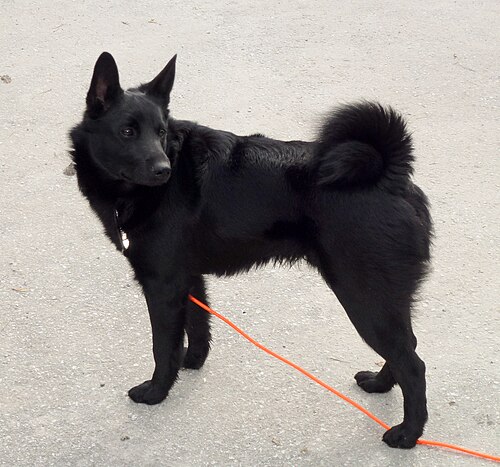
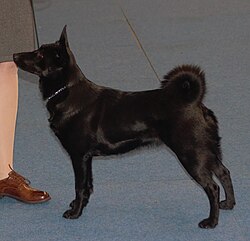
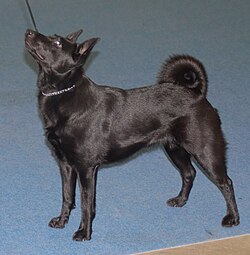
Black Norwegian Elkhound
🧠 Temperament & character
This Elkhound is lively, brave and a touch more agile than his grey relative. Towards his family he is loyal and affectionate, while towards strangers he is watchful at first, without being aggressive. His pronounced prey drive and his independence call for a person who understands him and guides him fairly but consistently. Towards children he is usually patient, and with other dogs he gets on well given good socialisation. Typical of the spitz: he can be fond of barking and likes to speak his mind.
📜 Origin & history
The black Elkhound emerged in the 19th century as an independent, smaller type of the Norwegian Elkhound and was first exhibited in 1877. Norwegian hunters valued his smaller size and agility in dense terrain, where he tracked down the elk, circled it and held it in place with his baying until the hunter approached. Besides this baying hunt, he also served as a leash dog, following a trail silently on a long lead. To this day he has remained above all a working hunting dog in Norway and is rarely encountered outside Scandinavia.
✂️ Grooming, care & training
The dense, weatherproof double coat with soft undercoat is pleasingly easy to care for and usually needs only weekly brushing. During the twice-yearly moult, however, he sheds heavily and should then be combed out daily. As an enduring hunting dog he needs plenty of exercise: long walks, hiking and mental tasks keep him balanced. His intelligence and his mind of his own make training interesting, but also demanding; varied, positive training with clear rules goes down best. A securely fenced garden is advisable, as otherwise his prey drive easily sends him wandering.
🩺 Health
The Black Norwegian Elkhound is considered a robust, weather-hardy breed with a life expectancy of around 12 to 15 years. As with many medium-sized dogs, attention should be paid to hip dysplasia, which is why reputable breeders x-ray their parent animals. Hereditary eye diseases, in particular progressive retinal atrophy (PRA), also occur and can be limited through eye examinations and genetic tests. Owing to the small population, the choice of a responsible breeder who pays attention to genetic diversity is especially important.
🏡 Who is this breed right for?
This Elkhound is best suited to active people and families who like to be out and about in nature. He can live in an apartment given enough activity, but feels considerably more comfortable with access to a garden and in a rural setting. For absolute first-time dog owners he is only suitable to a limited extent because of his stubbornness and prey drive; experience or good guidance helps a great deal. In Switzerland he is ideal for hiking- and mountain-loving owners who are looking for a weatherproof, enduring companion and can offer the necessary free running outside the wildlife protection area.