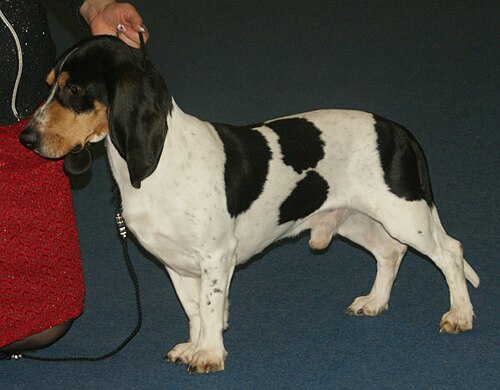
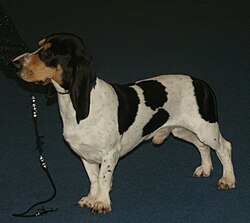
Swiss Small Hound
🧠 Temperament & character
The Swiss Small Hound is friendly, courageous and never aggressive, an easygoing dog with an excellent nose. He is passionate at work but, thanks to his shorter legs, somewhat more leisurely and easier to accompany than the large Swiss Hound. At home he shows himself affectionate, balanced and congenial. His hunting and scenting drive nonetheless remains strong and wants to be satisfied.
📜 Origin & history
The Swiss Small Hound emerged around 1900, when a need arose in Switzerland for smaller scent hounds for limited, often fenced hunting grounds due to cantonal hunting regulations. For this, shorter-legged dogs were bred from the Swiss Hound, partly by crossing in French basset breeds. He comes in the same four varieties as the large Swiss Hound; the FCI lists him under no. 60. To this day he is a typical Swiss hunting dog for smaller hunting areas.
✂️ Grooming, care & training
The Swiss Small Hound's short, dense coat is uncomplicated and needs only regular brushing. Despite his shorter legs he is an active hunting dog that needs plenty of exercise and extensive scent work, if somewhat less far-ranging than the large Swiss Hound. He is intelligent and friendly to handle, but follows a scent trail independently, so recall training and secured terrain remain important. The long pendulous ears should be checked regularly.
🩺 Health
The Swiss Small Hound is a robust breed with a life expectancy of about twelve to fourteen years and without strongly pronounced hereditary diseases. Because of the longer back and the short legs, attention should be paid to a healthy body weight to spare the back and joints. As with all scent hounds, the long pendulous ears must be cleaned and checked regularly. Responsible Swiss breeders pay attention to healthy, temperamentally sound parent animals and correct proportions.
🏡 Who is this breed right for?
The Swiss Small Hound is primarily a hunting dog, but thanks to his friendly nature and his more manageable size he is somewhat more versatile than the large Swiss Hound. In Switzerland too he is mostly kept by hunters, and his strong hunting drive requires corresponding occupation. For active, rurally living families who offer him exercise and scent work he can be a pleasant, congenial companion. A pure city apartment without occupation, however, does not suit him.