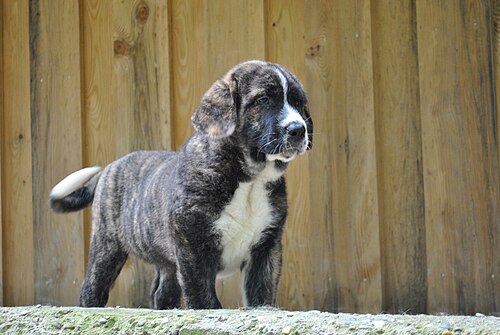
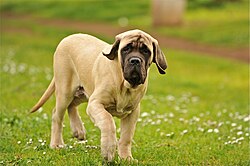
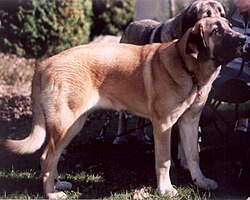
Spanish Mastiff (Mastín Español)
🧠 Temperament & character
The Spanish Mastiff is by nature calm, composed and self-assured, a deliberate giant who knows his strength and does not use it without reason. Towards his family he is gentle, patient and loyal, but towards strangers aloof and watchful, with a pronounced, deeply rooted protective instinct. As an independent livestock guardian dog he makes his own decisions and cannot be pushed into blind obedience. His imposing appearance and his deep bark have a deterrent effect, but at heart he is a balanced, dignified dog who radiates calm and composure.
📜 Origin & history
The Spanish Mastiff is one of the oldest dog breeds of the Iberian Peninsula and goes back to ancient molossers that probably arrived in the country with traders more than two thousand years ago. For centuries he accompanied the huge migratory flocks of the Mesta on their transhumance routes and defended millions of sheep against wolves and bears. He was so important that his value and his keeping were even regulated in historical documents. With the decline of migratory shepherding the numbers fell, but the breed survived and is today recognised by the FCI and once again in demand in Spain as a livestock guardian dog.
✂️ Grooming, care & training
The dense, medium-length coat of the Spanish Mastiff is weatherproof and relatively easy to care for, but must be brushed regularly, much more often during the moult. As an enormous, leisurely livestock guardian dog he needs no sport, but rather long, calm walks, plenty of space and ideally a real task – during growth, overloading the joints must be avoided at all costs. In training, patience, consistency and respect for his independence are required; he cannot be drilled, but is won over only through fair, calm guidance. Early, careful socialisation and secure fencing are indispensable for this large, territorial dog. His drooling and the high feeding costs should also be taken into account.
🩺 Health
As a giant breed, the Spanish Mastiff has a life expectancy of about 10 to 12 years and is prone to the typical problems of large dogs. These include above all hip and elbow dysplasia, the life-threatening gastric torsion and eyelid malformations such as entropion or ectropion. Responsible breeders x-ray hips and elbows and pay attention to healthy eyes, correct growth and a stable temperament. A moderate upbringing, appropriate feeding, a healthy weight and avoiding large meals around exertion are important precautions for as long and trouble-free a life as possible.
🏡 Who is this breed right for?
The Spanish Mastiff is suitable exclusively for experienced owners with a great deal of space, a well-secured, large plot and ideally a real guardian task in a rural setting. For an apartment, for beginners or for people without experience of large, independent guardian dogs, this colossus is completely unsuitable. Towards his family he is gentle and loyal, but his sheer size, his protective instinct, his drooling, his night-time barking and the high maintenance costs must be realistically considered. In Switzerland he is rare and is occasionally used as a livestock guardian dog; any cantonal regulations should be checked before acquiring one.