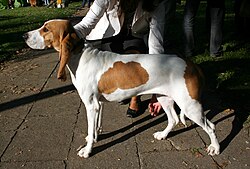

Swiss Hound
🧠 Temperament & character
The Swiss Hound is enduring, independent and downright obsessed with the trail once his nose has picked up a scent. At home he is balanced, friendly and affectionate, a good-natured companion with a gentle nature. He uses his melodious, far-carrying voice extensively when hunting. He needs genuine activity, because without hunting or an equivalent occupation this passionate hunting dog is not happy.
📜 Origin & history
The Swiss Hound looks back on a very long history; similar scent hounds have been documented in Switzerland since the Middle Ages and were valued abroad as 'Swiss braques'. From the regionally bred types emerged the present four varieties, which were combined in 1933 under a common standard. The FCI lists the Swiss Hound under no. 59. To this day he is used in Switzerland mainly by hunters for tracking and for hunting hare, roe deer and fox.
✂️ Grooming, care & training
The short, dense coat of the Swiss Hound is easy to care for and needs only regular brushing. Considerably more demanding is keeping him occupied: as a passionate scent hound he needs a great deal of daily exercise and, above all, intensive nose work such as tracking and search games. He is intelligent and willing to learn, but on a fresh trail he follows his instinct uncompromisingly, which is why recall training, impulse control and secure terrain are central. Without a real task he finds his own - usually with his nose to the ground.
🩺 Health
The Swiss Hound is a robust working breed selected for hunting, with a life expectancy of about twelve to fourteen years and without strongly pronounced breed-typical hereditary diseases. His long drop ears, however, tend towards infections and should be checked and cleaned regularly. After the hunt it is advisable to check him for ticks and injuries. Responsible Swiss breeders value healthy, sound-natured and capable parent animals.
🏡 Who is this breed right for?
The Swiss Hound is very much a hunting dog and in his homeland is mainly in the hands of hunters. In Switzerland, keeping him practically presupposes hunting or at least an equivalent form of activity, since without this task he can hardly be kept sufficiently occupied. For pure apartment living or inexperienced, not very active owners he is not suitable; ideal are a rural home and plenty of time in the field. With his family he is gentle and patient, also with children, but he requires people who understand and can channel his strong hunting drive.