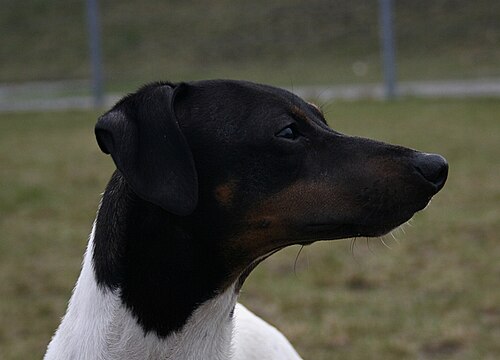
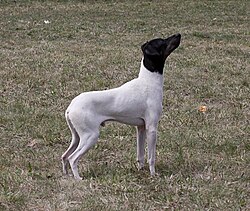
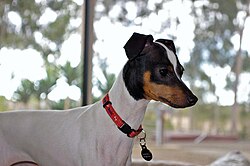
Japanese Terrier
🧠 Temperament & character
The Japanese Terrier is lively, cheerful, attentive and very affectionate towards his people, with whom he forms a close bond. He is more sensitive and calmer than many robust working terriers and more of a tender companion than a rough daredevil. Towards strangers he can be reserved, but within the family circle he shows himself playful and devoted. He is intelligent and willing to learn, but reacts sensitively to a harsh tone and therefore needs loving, calm training.
📜 Origin & history
The Japanese Terrier (Nihon Teria) arose from the 18th century onwards in the Japanese port cities, above all in the area of Nagasaki and later Kobe, where European traders brought smooth-haired terriers of the fox terrier type. These were crossed with small native dogs and toy breeds to create a fine, elegant companion dog. The breed's standard was fixed in Japan in the 1930s, but it remained rare even in its homeland. To this day the Japanese Terrier is one of the lesser-known and rarely bred terrier breeds.
✂️ Grooming, care & training
The Japanese Terrier's very short, smooth and fine coat is extremely easy to care for and needs only occasional brushing; he sheds little. Since he has hardly any undercoat and is delicately built, he is sensitive to cold and should be protected with a little coat in the Swiss winter. He is moderately active and is well occupied with daily walks, play and some mental stimulation. As a sensitive, clever dog he likes to learn, provided one works with him calmly, patiently and positively.
🩺 Health
Because of his rarity, only limited data is available on the Japanese Terrier's health, but overall he is considered a rather robust breed with a life expectancy of about twelve to fifteen years. As with many small breeds, patellar luxation (dislocation of the kneecap) can occur. Since the gene pool is small, preserving genetic diversity and careful breeding selection are of particular importance. Responsible breeders pay attention to healthy, temperamentally sound parent animals and avoid overly close matings.
🏡 Who is this breed right for?
The Japanese Terrier is well suited to quieter individuals, couples and families with older children who are looking for a small, sensitive and affectionate companion. Thanks to his size and his moderate temperament he is a good apartment and city dog who needs a lot of closeness to his people and does not like being left alone for long. He is suitable for empathetic first-time dog owners, provided they take his sensitivity and his sensitivity to cold into account. In Switzerland he is a great rarity, to be found above all through specialised breeders abroad.