

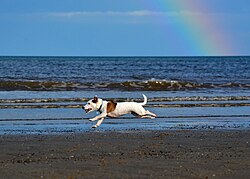
Jack Russell Terrier
🧠 Temperament & character
The Jack Russell Terrier is very active, highly intelligent and strongly hunting-motivated – a small dog with the self-assurance and stamina of a big one. He is brave, cheerful and very devoted to his family, but absolutely needs plenty of activity, otherwise he quickly becomes a loud, digging or wilful problem dog. His pronounced prey drive makes him problematic towards small animals, and he can also come across as forward with other dogs. He gets on well with older, active children, but for comfort-loving people he is the wrong choice.
📜 Origin & history
The Jack Russell Terrier goes back to the English parson and passionate fox hunter John 'Jack' Russell, who in the 19th century bred a high-performance white working terrier for mounted fox hunting. These terriers were meant to keep up with the foxhounds, corner the fox in its den and, thanks to their white colour, be clearly visible. Several types later developed from his breeding line; today's Jack Russell Terrier, with its rather low, elongated build, was officially recognised by the FCI in 2000, with Australia as the patron country. To this day he is first and foremost a work-loving, hunting-inclined terrier.
✂️ Grooming, care & training
The Jack Russell Terrier's coat comes in three varieties – smooth, rough and 'broken' (in between) – and is basically easy to care for; regular brushing is enough, and rough-haired types are additionally stripped. Far more demanding is his enormous need for exercise and mental activity: he needs plenty of daily running, play, training and tasks that challenge his alert mind. Ideal are dog sports such as agility, tracking or trick dog, because an under-challenged Jack Russell invents his own (often undesirable) occupations. He is very trainable but independent, which is why consistent, varied training is important.
🩺 Health
The Jack Russell Terrier is a remarkably robust and long-lived breed that often reaches thirteen to sixteen years and older. Patellar luxation, primary lens luxation and other eye diseases as well as congenital deafness, which can occur especially in strongly white-coloured dogs, may appear. For several of these hereditary problems (such as lens luxation and certain ataxias) DNA tests are available. Responsible breeders use these tests, have eyes and knees examined and check puppies for deafness.
🏡 Who is this breed right for?
The Jack Russell Terrier is best suited to very active, sporty people and families who offer him plenty of daily exercise, training and mental activity. For comfort-loving, quiet or inexperienced owners he is often unsuitable despite his popularity, because his energy and occupation needs are easily underestimated. He can live in an apartment if he is really kept busy, but an active environment with plenty of opportunity to run is ideal. In Switzerland he is a popular, adventurous companion for dog sports, hiking and active leisure – his strong hunting drive, however, requires good recall training.