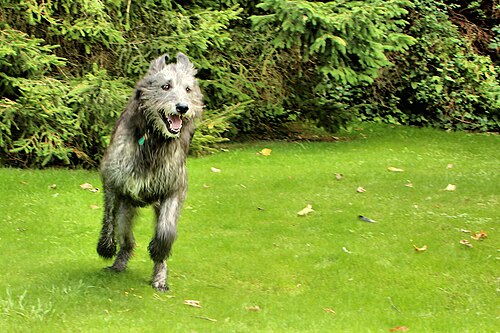
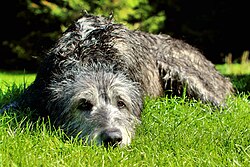
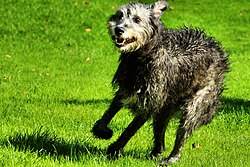
Irish Wolfhound
🧠 Temperament & character
The Irish Wolfhound is calm, gentle and good-natured, a proverbial gentle giant with a balanced temperament. He is loyal and lovingly devoted to his family and usually patient in his dealings with children, though his sheer size calls for caution. Towards strangers he is friendly to indifferent; he is no use as an aggressive guard dog, but his appearance alone has a deterrent effect. His hunting instinct is rather moderate compared with many other sighthounds, but is nonetheless present.
📜 Origin & history
The Irish Wolfhound is a very old Irish breed that was already famous in antiquity as a war and hunting dog and was used to hunt wolves and deer. These mighty dogs were regarded as precious gifts among kings and nobles and were once reserved for the high nobility. After wolves had been exterminated in Ireland, the breed lost its purpose and was on the verge of extinction in the 19th century. The Scottish officer George Augustus Graham rebuilt the breed from the last specimens, so that the gentle giant has survived to this day.
✂️ Grooming, care & training
The Irish Wolfhound's rough, wiry coat is relatively easy to care for and needs regular brushing as well as occasional stripping. As an adult he needs extensive but calm walks every day and the opportunity to gallop, but is relaxed and quiet in the home. Particularly important is a gentle growing-up: because of their rapid growth, puppies and young dogs must not be overtaxed, in order to protect their joints and bones. He is sensitive and willing to learn and needs friendly, patient training without harshness.
🩺 Health
Like many giant breeds, the Irish Wolfhound unfortunately has a very short life expectancy of often only six to eight years. Among the serious breed-typical risks are dilated cardiomyopathy (a disease of the heart muscle), the life-threatening gastric torsion and bone cancer (osteosarcoma). Responsible breeders have the heart examined regularly, pay attention to healthy bloodlines and give honest information about the breed's health problems. Calm feeding in portions and a gentle build-up during the growth phase are particularly important to protect the heart, stomach and skeleton.
🏡 Who is this breed right for?
The Irish Wolfhound suits people with plenty of space, a house with a garden, and an awareness that such a large dog brings corresponding effort and, unfortunately, a short lifespan. He is a calm, gentle family dog that gets on well with children, though his size demands consideration. Thanks to his good-natured character he can also be suitable for first-time owners, provided they realistically assess the costs, the space requirement and the health risks. In Switzerland the great need for space and food, the question of transport, and the willingness consciously to accompany a gentle giant for only a few years are things to consider.