Irish Water Spaniel
🧠 Temperament & character
The Irish Water Spaniel is intelligent, courageous and enduring, while being playful, headstrong and with a pronounced sense of humour. Towards his family he is affectionate and faithful, towards strangers he can be reserved at first. He is work-loving and trainable, but no mere order-taker – he likes to think along for himself. With humorous, varied training he unfolds his full, endearing nature.
📜 Origin & history
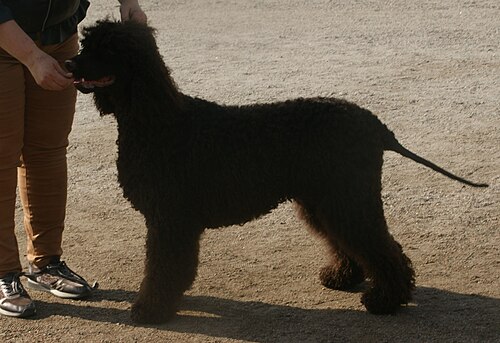
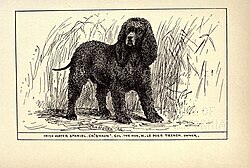
The Irish Water Spaniel in his present form goes back to Justin McCarthy in Dublin, who in the mid-19th century laid the foundation with his famous male 'Boatswain'. His exact ancestors are unclear, but old Irish water dogs, poodles and other spaniels are likely to have been involved. He was bred as a robust water retriever for the rough waterfowl hunting on Ireland's coasts and moors. His curly, oily coat and his powerful build made him a specialist for cold water.
✂️ Grooming, care & training
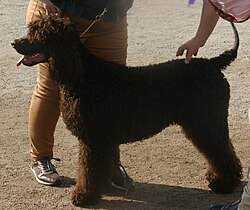
The Irish Water Spaniel's dense, curly and slightly oily coat barely sheds, but for that reason it must be combed regularly and stripped or trimmed into shape a few times a year, otherwise it mats. The drop ears need careful checking. As a high-performance water dog he has a high need for exercise and loves swimming, retrieving and tricky tasks. Mental activity is a must – monotonous training quickly bores this clever mind.
🩺 Health
The Irish Water Spaniel mostly reaches an age of around 10 to 12 years and is considered comparatively robust. Hip and elbow dysplasia, hereditary eye diseases and hypothyroidism can occur; in addition, individual animals react sensitively to certain anaesthetics and wormers. Since the gene pool is small, joint and eye examinations and careful breeding selection are especially important.
🏡 Who is this breed right for?
The Irish Water Spaniel suits active, humorous people and families who value an intelligent, somewhat headstrong dog with a great need for water and occupation. For sporty first-time owners he is manageable, provided they challenge him in a varied and positive way. Ideal is a nature-close home with access to water, preferably with a garden. As a low-shedding, rare companion he is of interest to allergy sufferers – in Switzerland, however, he is hardly ever encountered.