Irish Setter
🧠 Temperament & character
The Irish Setter is cheerful, effusive and exceptionally people-oriented – a real charmer. He often stays playful and childlike into old age and accordingly needs plenty of exercise and occupation. He usually meets strangers in a friendly way, which is why he is hardly suited as a watchdog. His sensitivity and his temperament call for patient, loving and consistent guidance.
📜 Origin & history
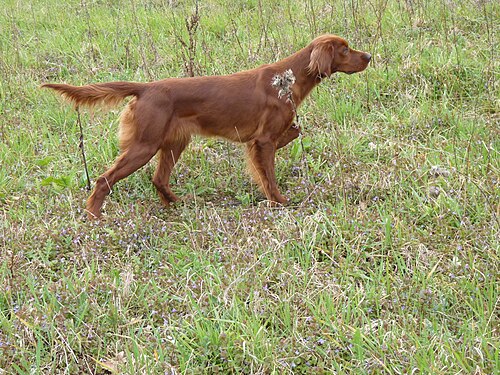
The Irish Setter arose in Ireland from various setter and spaniel strains, with red-and-white dogs originally also being common. In the 19th century the solid chestnut-red appearance that characterises the breed to this day prevailed. As an elegant and fast pointing dog he quickly became popular worldwide, both with hunters and at shows. This popularity unfortunately at times encouraged one-sided breeding for beauty.
✂️ Grooming, care & training
The long, silky coat of the Irish Setter with its pronounced feathering needs brushing several times a week to avoid knots and matting. As an energetic hunting dog he needs a great deal of exercise every day, ideally with plenty of off-leash running. His clever but easily distracted mind benefits from varied training and scent work. In training the sensitive red dog needs patience, positive motivation and plenty of consistency.
🩺 Health
The life expectancy of the Irish Setter is around 12 to 14 years. Typical of the breed are progressive retinal atrophy (PRA) and – as a deep-chested breed – the dangerous gastric torsion; hip dysplasia and epilepsy also occur. Reputable breeders use DNA tests for PRA and CLAD and have the hips x-rayed. Meals spread over the day and rest after eating help to reduce the risk of gastric torsion.
🏡 Who is this breed right for?
The Irish Setter suits active, patient people and families who have plenty of time for exercise and shared activities. For comfort-loving owners, pure apartment living without exercise or people looking for a calm dog he is unsuitable. In Switzerland he is an enthusiastic companion for hiking, jogging and dog sports. He usually gets on excellently with children, but in his exuberance may occasionally knock them over.