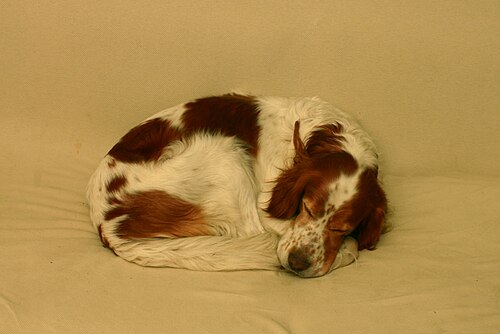
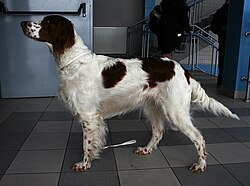
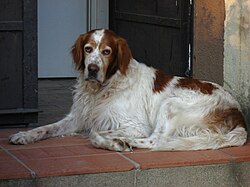
Irish Red and White Setter
🧠 Temperament & character
The Irish Red and White Setter is cheerful, work-loving and exceptionally people-friendly. He is somewhat more down-to-earth and robust in nature than the Irish Setter, while being just as energetic and ready to learn. At home he shows himself affectionate and compatible, in the field enduring and passionate. Without sufficient occupation the lively dog quickly becomes restless and looks for his own pursuits.
📜 Origin & history
The red-and-white setter is regarded as the older of the two Irish setter varieties and was long the preferred hunting dog of the Irish nobility. With the rise of the fashionable, pure red Irish Setter he fell strongly behind in the 19th century and stood on the brink of extinction at the beginning of the 20th century. Dedicated breeders, among them clergymen and hunters, laboriously rebuilt the population from the 1920s onwards. Today the breed is rare, but recognised again as a high-performance working setter.
✂️ Grooming, care & training
The silky, medium-length coat with its characteristic feathering needs regular brushing to prevent matting and burrs. As an active hunting dog the Irish Red and White Setter needs a great deal of exercise every day, best with extensive free running and nose work. His clever, sensitive character wants to be kept busy - tracking, dummy training or dog sports do him good. In training he responds much better to friendly consistency than to pressure.
🩺 Health
The life expectancy of the Irish Red and White Setter is around 11 to 13 years. Breed-specific are several hereditary diseases, among them the immune deficiency CLAD, progressive retinal atrophy (PRA) and the von Willebrand blood-clotting disorder. Responsible breeding here absolutely requires DNA tests of the parent animals in order to avoid affected puppies. The hips too should be X-rayed; a good breeder discloses all the certificates.
🏡 Who is this breed right for?
The Irish Red and White Setter suits very active people and families who take pleasure in exercise, nature and shared occupation. For quiet households or pure apartment keeping without exercise he is unsuitable - he needs space and tasks. In Switzerland he is a great companion for long hikes, hunting or demanding dog sports. He usually gets along well with children, provided he himself is kept occupied.