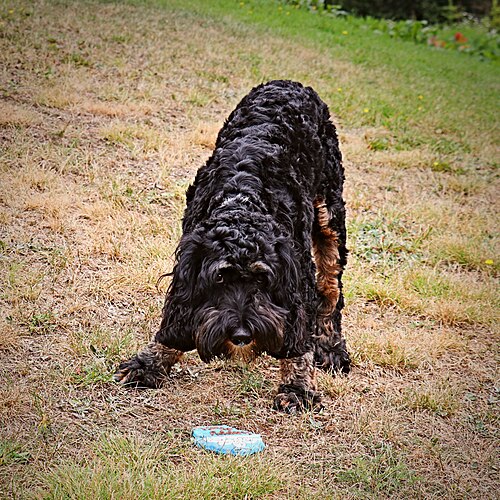
Standard Poodle
🧠 Temperament & character
The Standard Poodle is highly intelligent, eager to learn and very people-oriented - he wants to be kept busy and involved in the family. He is loyal, sensitive and easy to train, which makes him one of the cleverest dogs of all. Towards strangers he is usually friendly but attentive, and he gets on well with children and other animals. Without sufficient mental and physical activity, however, his great intelligence can discharge itself in bad habits.
📜 Origin & history
The poodle was originally bred as a water-retrieving dog that fetched shot waterfowl from lakes and rivers - hence the name, which goes back to the Old German 'puddeln' (to splash in water). The characteristic clip arose for practical reasons: it protected the joints and organs in cold water, while the rest of the coat was shortened for greater freedom of movement. France is regarded as the country of origin of the breed, where the poodle soon rose from a hunting dog to the elegant society dog of the nobility. Over the centuries the smaller varieties were bred down from the Standard Poodle.
✂️ Grooming, care & training
The curly, barely shedding coat of the Standard Poodle is high-maintenance: it must be brushed regularly and professionally clipped every few weeks, otherwise it mats quickly. The sporty dog needs plenty of exercise and, above all, mental work - retrieving, dog sports, nose work or trick training give him great pleasure. Thanks to his intelligence he learns extremely quickly and wants real tasks. Whoever keeps him occupied mentally and physically has an uncomplicated, obedient companion.
🩺 Health
The Standard Poodle is regarded as a robust dog with a life expectancy of about 12 to 14 years. Breed-typical are hip dysplasia, the life-threatening gastric torsion, the hormonal Addison's disease and sebaceous adenitis, which damages the coat. Serious breeders have the hips, eyes and in part DNA examined and pay attention to healthy, sound-natured parent animals. Because of the risk of gastric torsion, the large dog should be allowed to rest after eating.
🏡 Who is this breed right for?
The Standard Poodle suits active, committed people and families who can offer him plenty of occupation and closeness. Thanks to his eagerness to learn, he is also suitable for first-time owners, provided they are willing to invest time in training, activity and coat care. As a large dog he feels most comfortable in a house with a garden, but also copes in a larger apartment if he gets enough exercise. In Switzerland he is a versatile companion for hiking, dog sports and active family life.