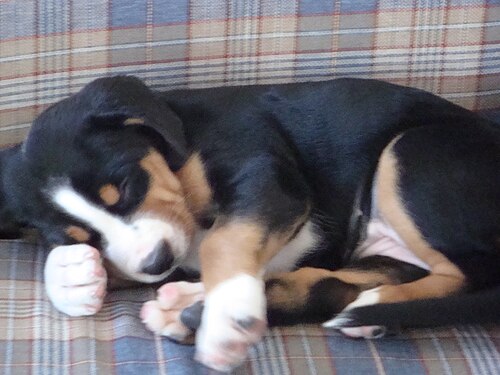
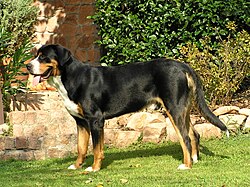
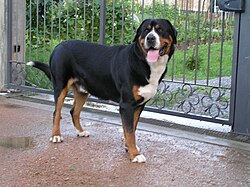
Greater Swiss Mountain Dog
🧠 Temperament & character
The Greater Swiss is even-tempered, attentive and good-natured, devotedly loyal to his family and self-assured towards strangers without being pushy. He rarely barks without reason and seems calm and composed in many situations. With children he is usually patient and gentle, but because of his size he should always be supervised. Despite his composure he needs close family contact and suffers if he is left alone a lot.
📜 Origin & history
The Greater Swiss Mountain Dog comes from Switzerland, where he served as a powerful draught, droving and farm dog on farms and with butchers. Towards the end of the 19th century the breed was regarded as almost extinct, until the cynologist Albert Heim rediscovered it around 1908 and established it as a breed in its own right. The former working dog has today become a valued family and farm dog that also shines in carting sport.
✂️ Grooming, care & training
The short, dense double coat of the Greater Swiss is easy to care for but sheds heavily during the moult and then needs more frequent brushing. His need for exercise is moderate: he loves regular walks and tasks such as pulling a cart, but he is not a restless long-distance runner. It is important that puppies grow up moderately so that the joints of this heavy dog mature healthily; jumping and stairs should be limited in the first year. Mentally, he is kept content with calm, consistent occupation.
🩺 Health
Like many large breeds, the Greater Swiss Mountain Dog has a limited life expectancy of around eight to eleven years. Breed-typical problems include hip dysplasia, the life-threatening gastric torsion and occasionally epilepsy; orthopaedic problems during growth also occur. Responsible breeders X-ray the hips and pay attention to healthy lines. A healthy weight, several small meals and rest after eating support the health of this giant.
🏡 Who is this breed right for?
The Greater Swiss Mountain Dog suits families and people with enough space who are looking for a calm, loyal companion with moderate exercise needs. Ideal is a house with a garden; for a small city apartment the large dog is less suitable. As he is very people-oriented, he should live closely within the family and not be left alone for long. As a Swiss dog rich in tradition, he is also suitable for well-prepared first-time owners who are aware of his size and strength.