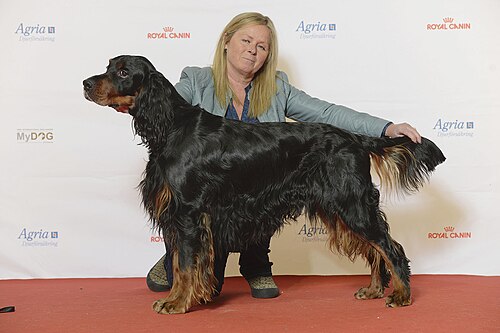
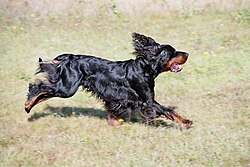
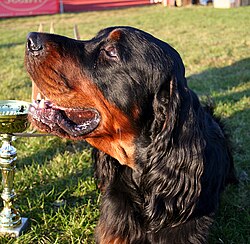
Gordon Setter
🧠 Temperament & character
The Gordon Setter is loyal, sensitive and exceptionally people-oriented – he often bonds especially closely with one person. Somewhat more independent and serious than his red relatives, he nonetheless works in a focused and enduring manner. Towards strangers he is rather reserved without being unfriendly, and within the family circle he shows himself gentle and cuddly. His pronounced urge to move calls for genuine physical and mental exercise.
📜 Origin & history
The Gordon Setter owes his name to the Duke of Gordon, who at the end of the 18th century deliberately bred black-and-tan setters at Gordon Castle in Scotland. These dogs were regarded as especially enduring and weather-hardy, ideal for hunting in the rugged Highlands. In the 19th century the breed spread beyond Great Britain and was recognised as an independent setter. To this day the Gordon Setter stands for the combination of working performance and Scottish tradition.
✂️ Grooming, care & training
The Gordon Setter's silky, medium-length coat with its feathering on the ears, legs and tail needs brushing several times a week to avoid matting. As a high-performance hunting dog he needs a great deal of daily exercise – long running, free running and scent work are part of the compulsory programme. His clever mind also wants to be challenged, for instance through tracking, dummy work or search games. In training he reacts sensitively to harshness and needs patient, consistent and fair leadership.
🩺 Health
The life expectancy of the Gordon Setter is around 11 to 13 years. Breed-typical conditions are progressive retinal atrophy (PRA), hip dysplasia and – as a deep-chested breed – the life-threatening gastric torsion; a hereditary cerebellar disease also occurs. Reputable breeders use DNA tests for PRA and ataxia and X-ray the hips. Feeding in calm and meals spread over the day lower the risk of gastric torsion.
🏡 Who is this breed right for?
The Gordon Setter suits active, dog-experienced people who can offer him plenty of daily exercise and close companionship. For beginners, comfort-lovers or pure city apartments without exercise he is less suitable – he needs space, tasks and closeness. In Switzerland he is a wonderful companion for extended hikes, hunting or demanding dog sport. With children he gets on well, provided he himself is balanced and well exercised.