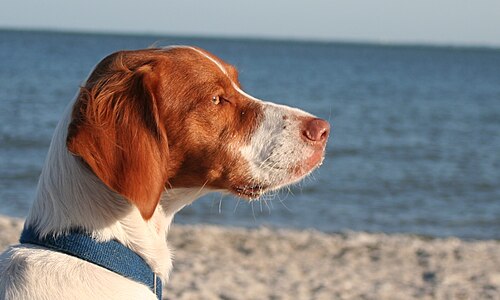
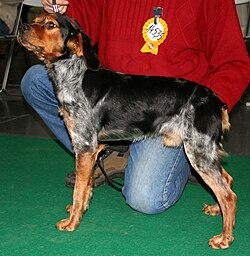
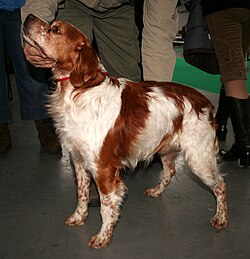
Brittany
🧠 Temperament & character
The Brittany is cheerful, affectionate and exceptionally people-oriented. It works closely together with its person, learns quickly and wants to please – which makes it biddable and pleasant in everyday life. At the same time, a big engine sits in the small body: without sufficient activity it quickly becomes nervous or finds occupations of its own. It usually meets children and other dogs in a friendly and open manner.
📜 Origin & history
Its roots reach back to the centre of Brittany, where farmers and poachers needed an agile, versatile dog for hunting on foot. In the 19th century English setters probably contributed, which gave the Brittany its pointing aptitude and the typical coat markings. In 1907 the first standard was established, and since then the breed has developed into one of France's most numerous hunting dogs. Today the Brittany is valued worldwide as a high-performance and family-friendly pointing dog.
✂️ Grooming, care & training
The Brittany's medium-length, slightly wavy coat is easy to care for and needs only regular brushing, especially on the feathered legs and ears. More important than coat care is exercise: this dog needs several hours of exercise a day, preferably combined with nose work or retrieving games. Its alert mind wants to be occupied – dummy training, tracking or dog sports keep it balanced. Thanks to its eagerness to learn and its biddability, training also succeeds for less experienced owners, provided they remain consistent and fair.
🩺 Health
The Brittany is considered a robust and long-lived breed with a life expectancy of around 13 to 15 years. Occasionally hip dysplasia occurs, more rarely also epilepsy or eye diseases. Reputable breeders X-ray the hips of their parent animals and pay attention to healthy, temperamentally stable lines. Anyone looking for a puppy should insist on corresponding health certificates.
🏡 Who is this breed right for?
The Brittany is best suited to active people and families who spend a lot of time outdoors and can offer it a meaningful task. For keeping purely in an apartment without activity it is unsuitable – it flourishes with exercise, play and a close bond. In Switzerland it is excellently suited as a companion for hiking, jogging or dog sports, and with its friendly manner it fits well into family life. Even for sporty first-time owners it is worth considering thanks to its biddability.